Dental · Dental Implants
Multiple Dental Implants in Turkey: Why Fewer Can Be Better
- Visits
- 2 trips as standard; 3 if staged grafting is needed
- Days in Turkey
- 4–6 days on trip one; 5–8 days on trip two
- Recovery period
- 5–10 days of swelling; soft diet on the treated side for 6–8 weeks
- Expected lifespan
- Implants 20+ years; screw-retained implant bridge 10–15+ years
Want the full picture first?
Read the hub page before comparing single options.
Key facts - Multiple dental implants replace two or more missing teeth, usually supporting an implant bridge rather than one implant per tooth. - Two implants supporting a three-unit bridge is often biologically sounder than three adjacent implants, because implants placed closer than 3 mm lose the bone between them. - A systematic review reported 95% survival for implant-supported bridges at 5 years and about 87% at 10 years. - A three-unit bridge on two implants typically costs £1,600–£2,800 in Turkey.
Why Fewer Implants Can Be Better
Patients looking into multiple dental implants in Turkey are often quoted the simplest formula: three missing teeth, three implants. It sounds logical, but it is not how experienced prosthodontists plan. The number of implants depends on the bone available, the biting forces and the soft tissue, not on the number of teeth.
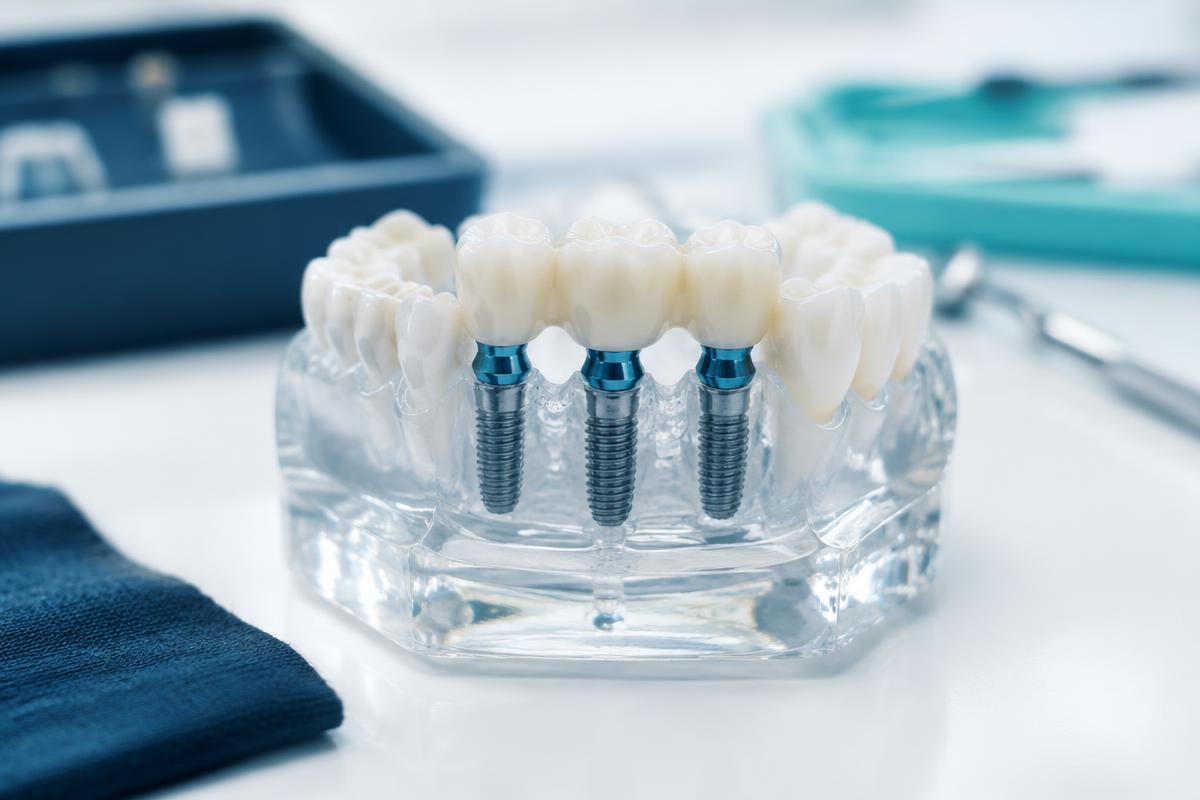
For a gap of three teeth, the usual approach is an implant-supported bridge on two implants: one at each end and a pontic (a tooth with no root beneath it) in the middle. For four missing front teeth, two implants in the lateral incisor positions can support a four-unit bridge with two pontics.
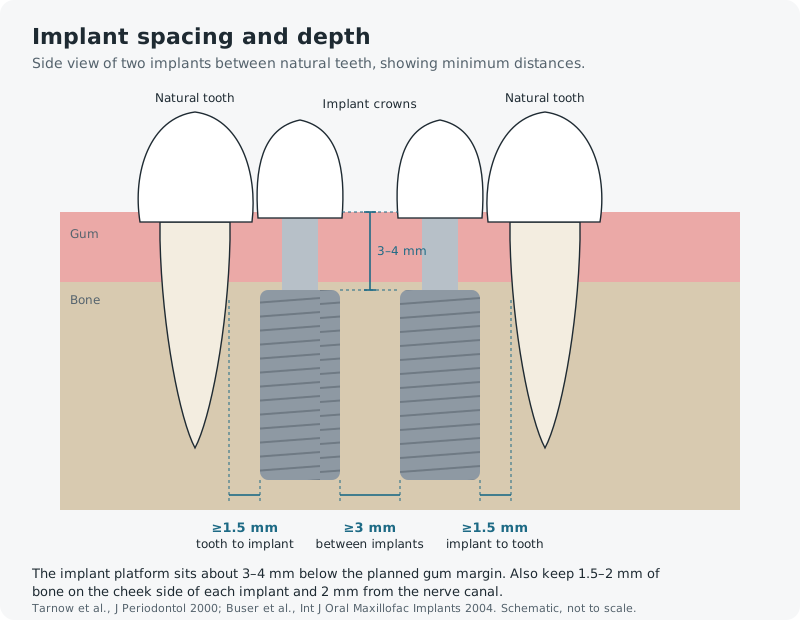
This is not a compromise. Adjacent implants need at least 3 mm of bone between them; closer spacing leads to loss of the bone crest between them.3 Even with correct spacing, the papilla between two implants averages only around 3–4 mm in height and tends to look blunted.4 A pontic, by contrast, sits in gum that can be shaped to mimic a natural papilla. Every extra implant is also another surgical site, another area of bone that must exist, and another potential site of peri-implantitis.
The evidence supports implant bridges. A systematic review found implant survival of about 95% at 5 years and 93% at 10 years in implant-supported bridges, with bridge survival of 95% and 87% respectively.1 The same review noted that only around 61% of patients were free of any complication after 5 years,1 which is why careful design and maintenance matter.
There are exceptions. Long spans, short implants in poor bone and patients who grind heavily may justify more implants. That should be explained from your CBCT, not applied by default.
Bone Loss After Extraction and Implant Positioning
Bone loss after extraction follows a predictable pattern. In a 12-month prospective study, the alveolar ridge lost up to half of its width within the first year after a tooth was removed, with much of the change in the first few months.2 The thin buccal wall goes first, so the ridge narrows before it loses height.
When several adjacent teeth are removed, the bony septa between their sockets disappear too. The ridge flattens, and the bone peaks that supported the papillae are lost. The jaws resorb in different directions:
- The maxilla shrinks upwards and inwards, while the sinus expands downwards into the space above missing back teeth.
- The posterior mandible loses height, bringing the nerve canal closer to the ridge crest.
A CBCT decides whether implants can go straight in, need guided bone regeneration, or need a sinus lift first.
Implants are positioned for the prosthesis, not wherever bone happens to be. In a posterior three-unit gap they usually go at the first and third positions. In a four-incisor gap, implants at the lateral incisors support pontics at the centrals, which is the most aesthetic arrangement. The rules on spacing and depth are set out in our implant positioning guide.
Implants are splinted together by the bridge, which spreads chewing forces. They should not be connected to natural teeth: a tooth moves slightly in its ligament while an implant is effectively rigid, and joining them leads to intrusion of the tooth, cement failure and overload of the implant.
Occlusal plane realignment is often needed too. Teeth missing for a long time allow opposing teeth to over-erupt and neighbouring teeth to tip. Over-erupted teeth may need reshaping, a crown or occasionally orthodontic correction so the new bridge is not overloaded. Where wear and tooth loss are widespread, the problem may call for full mouth reconstruction planning instead.
Implant Bridges, Frameworks and Soft Tissue
Most implant bridges are screw-retained on multi-unit abutments or titanium bases. Screw retention allows removal for maintenance and avoids excess cement under the gum. It does require passive fit: a bridge that strains even slightly as it seats transfers that stress to the bone and screws, so accurate scanning and verification are essential.
For short spans, monolithic zirconia is strong enough for back teeth, while multilayer zirconia or layered ceramics suit front teeth.
Longer spans of five or six teeth, or major tissue loss, often call for a custom titanium bar: a CAD/CAM-milled titanium framework carrying zirconia crowns or composite teeth. Titanium gives rigidity and accurate fit over longer distances, and individual crowns can be replaced without remaking the whole structure. Where vertical bone loss is significant, pink ceramic or composite restores the gum contour instead of creating very long teeth.
Soft tissue conditioning turns a functional bridge into a natural-looking one. During the provisional phase, an ovate pontic is gradually built up to press gently into the gum, forming a concave site that resembles a tooth emerging from the gum. Custom healing abutments shape the tissue around the implants in the same way, and the laboratory then copies these contours into the final bridge.
Planning Your Trips
Before travel: records. Send a CBCT, photographs and dental history so the clinic can assess bone, grafting needs and the opposing teeth before you book.
Trip one, day 1: assessment. Examination, CBCT, scans and bite records establish bone availability, grafting needs and any occlusal correction.
If grafting is needed first. Guided bone regeneration or a sinus lift is carried out, and you return after 4–9 months for implant placement.
Trip one, day 2: guided surgery. Remaining extractions are done and implants placed through a surgical guide, with insertion torque recorded and healing or multi-unit abutments fitted.
Trip one, days 3–5: provisional. A fixed or removable provisional is fitted; at the front, soft tissue conditioning begins.
Trip two, months 3–4 (lower jaw) or 4–6 (upper jaw). Integration is checked, the provisional adjusted to finish shaping the gum, and definitive scans taken. A framework try-in confirms passive fit, then shade and bite are checked before the bridge is torqued in place and confirmed on X-ray. A night guard is made if you grind.
Reading a Multi-Implant Quote
One implant per missing tooth by default. Clinics that charge per implant earn more from three implants than from two, even when a two-implant bridge is the safer standard. Ask the clinic to show on your CBCT why each implant is needed. Indicative pricing is £1,600–£2,800 in Turkey for a three-unit bridge on two implants, against £5,000–£8,000 in the UK.
"Per unit" pricing that hides the design. "3 implants + 3 crowns" says nothing about how the teeth connect. Check whether the plan is a splinted bridge or separate crowns, uses multi-unit abutments or titanium bases, and is screw-retained or cemented.
Unpriced occlusal correction and grafting. Adjusting or crowning over-erupted teeth, sinus lifts, bone grafts and the provisional bridge are often left out. Ask for them to be listed as conditional items.
Candidacy
Ideal candidates
- Two or more adjacent missing teeth with healthy teeth elsewhere.
- Adequate bone at the planned implant positions, or acceptance of grafting.
- Non-smokers with stable periodontal health and good hygiene.
Contraindications & complications
- Untreated periodontitis, uncontrolled diabetes, heavy smoking, IV bisphosphonates or radiotherapy to the jaw.
- Severe over-eruption of opposing teeth that the patient does not want corrected.
- Complications include non-passive fit, screw loosening, porcelain chipping, peri-implantitis, papilla loss between adjacent implants, and food trapping under poorly contoured pontics.
Multiple Implants vs Single Implants
A single dental implant is the right choice for one missing tooth between healthy neighbours, with no connections and normal flossing.
For several adjacent missing teeth, an implant per tooth needs more bone, more surgery and closer spacing, and tends to produce blunted papillae. A splinted bridge on fewer implants spreads the load, needs less bone and allows natural-looking pontic sites. Where implants are not possible, a tooth-supported dental bridge remains an option.
Frequently Asked Questions
Is a bridge on two implants weaker than three separate implants?
Not in normal function. A three-unit bridge splinted on two well-placed implants spreads chewing force across both, and systematic reviews report survival of about 95% at five years for implant-supported bridges. The pontic carries load through the connectors to the implants, well within the capacity of modern zirconia and titanium. Three implants become worth considering when the span is long, only short implants are possible, or the patient grinds heavily. In most gaps, a third implant adds cost, surgery and hygiene burden without meaningful mechanical benefit.
Why can't the implant be joined to my natural tooth?
A natural tooth is suspended in its socket by the periodontal ligament, which allows slight movement under load, whereas an implant is fused to bone and moves far less. When the two are joined by a rigid bridge, forces concentrate on the implant, the natural tooth can gradually intrude into its socket, and the cement between them can fail. Tooth-implant bridges have higher complication rates than bridges supported only by implants. That is why implant bridges are supported by implants alone, with natural teeth restored separately.
Why does the clinic want to adjust my opposing teeth?
When teeth have been missing for months or years, the opposing teeth often drift into the gap, a process called over-eruption. If the new bridge were built to meet them where they now sit, the bite plane would be uneven, and the bridge would be struck heavily during side-to-side movements, overloading the implants and ceramic. Restoring the correct bite plane may involve minor reshaping, a crown on a severely over-erupted tooth, or orthodontic intrusion. A good plan identifies this on the first scans and includes it in the quote.
Will I need bone grafting after losing several teeth?
Often, yes, especially if the teeth were lost some time ago. After extraction, the ridge can lose up to half its width within a year, and in the upper back jaw the sinus also expands into the space the roots occupied. Only a CBCT can show whether the remaining bone allows implants of adequate size. Minor deficiencies can often be grafted at the same time as implant placement using particulate bone and a membrane. Larger defects, or a low sinus floor, need staged grafting with four to nine months of healing and an extra trip.
References
- Pjetursson BE, Tan K, Lang NP, Brägger U, Egger M, Zwahlen M. A systematic review of the survival and complication rates of fixed partial dentures (FPDs) after an observation period of at least 5 years. I. Implant-supported FPDs. Clin Oral Implants Res. 2004;15(6):625–642. doi:10.1111/j.1600-0501.2004.01117.x
- Schropp L, Wenzel A, Kostopoulos L, Karring T. Bone healing and soft tissue contour changes following single-tooth extraction: a clinical and radiographic 12-month prospective study. Int J Periodontics Restorative Dent. 2003;23(4):313–323. PubMed
- Tarnow DP, Cho SC, Wallace SS. The effect of inter-implant distance on the height of inter-implant bone crest. J Periodontol. 2000;71(4):546–549. PubMed
- Tarnow D, Elian N, Fletcher P, et al. Vertical distance from the crest of bone to the height of the interproximal papilla between adjacent implants. J Periodontol. 2003;74(12):1785–1788. PubMed