Dental · Dental Veneers
Composite Veneers in Turkey: The Reversible First Step
Want the full picture first?
Read the hub page before comparing single options.
Key facts - Composite veneers are built directly on the tooth in tooth-coloured resin, usually with little or no enamel removed, which makes them effectively reversible. - They stain, lose their polish and chip more readily than porcelain, so expect a professional polish every 6–12 months and refurbishment every few years. - Direct bonding usually takes 2–4 days and should cost far less than porcelain, typically £80–£200 per tooth in Turkey.
When Composite Is the Smarter First Step
Composite veneers in Turkey are often presented as the budget version of porcelain. That undersells their main advantage, which is biological rather than financial. With direct resin bonding, the dentist sculpts composite onto the natural tooth, usually without cutting into the enamel at all.
Done this way, the treatment is effectively reversible. If you change your mind, if the composite ages, or if you later want porcelain veneers, the composite can be removed and your original teeth are still there. For young adults, and for small gaps, minor chips, worn edges or slightly short teeth, that is a major advantage over any ceramic option. It is also the logical first step in an ethical Hollywood smile.
The limitations are real:
- Staining. Resin absorbs pigments from coffee, tea, red wine, curry and especially tobacco.
- Loss of polish. Surface gloss fades over months, and a dull surface stains and collects plaque more readily.
- Chipping. Composite chips more easily than porcelain, particularly at the biting edges.
- Maintenance. Expect a professional polish every 6–12 months and some refurbishment every few years.
The clinical evidence reflects this. A systematic review of anterior composite restorations reported annual failure rates of roughly 0–4%, with front-tooth restorations replaced less often for decay and more often for other reasons, such as appearance.1 In a clinical trial comparing direct composite, indirect composite and porcelain veneers on upper incisors, porcelain showed the best overall survival, and veneers on non-vital teeth failed more often than those on vital teeth.2
The result also depends heavily on the individual dentist. There is no laboratory ceramist: shape, layering and polish are created entirely by hand in the chair.
How Direct Bonding Holds On
Composite veneers rely on bonding to enamel:
- The enamel is etched with 37% phosphoric acid, creating a micro-rough surface.
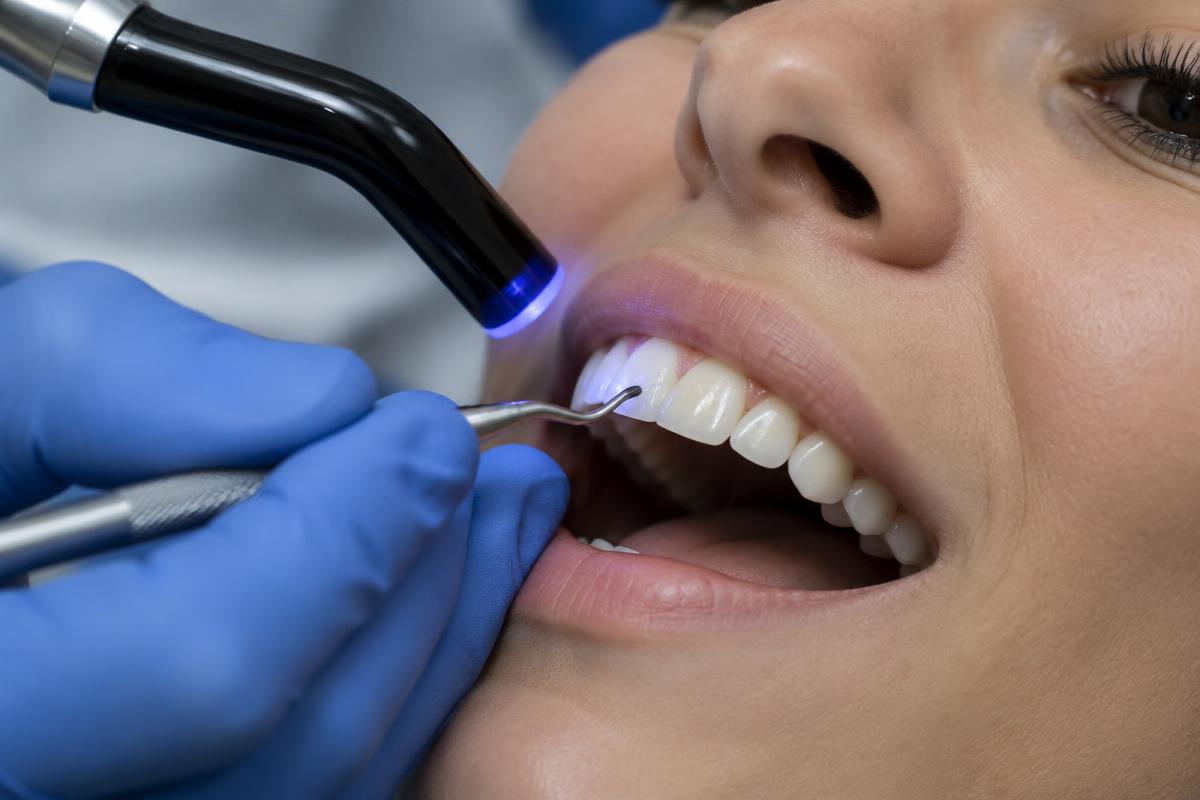
- An adhesive resin flows into the micro-pits and is light-cured.
- Composite is layered on top and bonds chemically to the adhesive.
Bonds to intact enamel are strong and durable, which is why zero-prep composite veneers work. Minimal prep involves light roughening of the outer enamel, sometimes with a very shallow chamfer of about 0.2–0.3 mm at the margins so the composite blends in without a ledge. Even then, the preparation stays in enamel, and the tooth remains in excellent condition for porcelain later.
Reversibility has one nuance. Removing composite from etched enamel with a bur can take a few micrometres of enamel with it, so the treatment is "effectively" rather than absolutely reversible. That loss is negligible compared with any ceramic preparation.
Marginal leakage is composite's main weakness. Composites shrink by roughly 2–3% in volume as they cure, which pulls on the bond at the margins. If the bond there gives way slightly, a thin gap forms that absorbs pigments and bacteria, showing up as a brown or white line at the edge. Building the composite up in small increments, keeping margins in enamel and careful finishing all reduce the risk.
Chipping repair is straightforward: the area is roughened, re-etched, bonded and rebuilt with new composite, usually in one short appointment without anaesthetic. A chipped porcelain veneer, by contrast, often needs replacing.
Composites, Layering and the Final Polish
Composites differ mainly in the size of their filler particles:
- Micro-hybrid composites (particles of roughly 0.4–1 µm) are strong and suit incisal edges, but their gloss fades somewhat faster.
- Nano-fill composites (such as 3M Filtek Supreme) use nano-sized particles and clusters. They polish to a high gloss and keep it longer.
- Nanohybrid composites (such as Ivoclar Tetric EvoCeram or IPS Empress Direct, GC Essentia or Tokuyama Estelite) balance strength and polishability.
- Specialist aesthetic systems such as Enamel Plus HRi offer dentine and enamel shades with optical properties close to natural teeth.
The layering technique mimics a natural tooth. A silicone key from the wax-up guides a thin palatal shell of enamel shade. Dentine-shade composite builds the body and colour, effect shades add translucency or halos at the edge, and a final enamel layer of about 0.3–0.5 mm provides lustre. A single-shade "bulk" application is quicker but looks flat and opaque.
Polishability is the final, critical step. Sequential discs, rubber points and polishing pastes take the surface to a high shine. Rougher surfaces attract more plaque and stain faster, so the quality of this polish largely decides how quickly the veneers will discolour.
Two to Four Days in the Chair
Day 1: assessment and design. Teeth and gums are examined, and photographs and scans used to design the smile. Teeth whitening is usually done first, because composite does not change colour afterwards, and bonding should wait about two weeks after whitening.
Day 2: bonding. The teeth are isolated, lightly roughened if needed, etched and bonded. Composite is layered tooth by tooth, which typically takes 45–90 minutes per tooth for a fully layered result.
Day 3: finishing. Once the composite has fully set and the teeth have rehydrated, the shape is refined, the bite adjusted and the final polishing sequence completed.
Day 4: review. Speech, bite and appearance are checked, and you receive a maintenance schedule and, where needed, a night guard.
Every 6–12 months. A professional polish and small repairs, which any experienced local dentist can provide.
Fair Prices for Direct Bonding
Composite veneers involve no laboratory fees and often only one or two appointments, so they should cost much less than porcelain. In Turkey, expect roughly £80–£200 per tooth; porcelain veneers there typically cost £200–£450. Be cautious if a clinic charges near-ceramic prices for composite work.
Equally, composite rarely needs significant enamel removal. A clinic planning to drill teeth heavily for composite veneers has discarded the treatment's main advantage. Ask for any planned preparation in writing.
Finally, a quote that just says "composite" tells you nothing about the brand, whether the veneers will be layered or single-shade, or whether finishing and polishing are included. Ask for these details, and for the brand and shades to be recorded for future repairs.
Who It Suits
Composite veneers suit young adults and anyone who wants a reversible, conservative change: small gaps, minor chips, worn edges, slightly short teeth or mild misalignment. They work best for people willing to have the veneers polished every 6–12 months and to moderate staining habits. Heavy smokers, frequent coffee, tea or red wine drinkers, and people who grind or bite their nails will find them harder to maintain. They are also less suitable where discolouration is too dark for composite to mask, or where teeth already carry large restorations. The common problems are staining, loss of gloss, chipping, marginal discolouration and bulky contours if the veneers are poorly shaped.
When to Move to Porcelain
Porcelain veneers are laboratory-made and need 0.3–0.7 mm of enamel reduction. In return they resist staining, keep their glaze for years and last considerably longer. For very thin ceramic options, see laminate veneers.
Composite is often the sensible first step; porcelain is the long-term option once you are sure of the change you want, or if maintenance becomes a burden. A clip-on appliance is not a substitute for either.
Frequently Asked Questions
Are composite veneers really reversible?
With zero-prep or minimal-prep veneers, effectively yes. Because the composite is bonded to enamel without significant drilling, it can be removed later with fine burs and polishing instruments, leaving the original tooth essentially intact. A few micrometres of surface enamel may be lost during removal, which is minimal compared with porcelain veneer or crown preparation. If the teeth were drilled substantially before the composite was placed, the treatment is no longer reversible. Ask the dentist to confirm in writing that no enamel will be removed, or only light surface roughening.
How often do composite veneers need maintenance, and can it be done at home?
Plan on a professional polish every 6–12 months, depending on diet and habits; heavy coffee, tea, wine or tobacco use may call for six-monthly polishing. Every three to five years, some refurbishment is typical: re-polishing, adding composite at chipped edges, or replacing a discoloured surface layer. Any dentist experienced in composite work can do this at home. Ask the clinic for the brand and shade names of the composites used, so repairs match. Regular hygienist cleaning with non-abrasive pastes also helps preserve the surface finish.
My composite veneer has chipped. Do I need to go back to Turkey?
Usually not. Chips can be repaired directly in the mouth by any competent dentist: the area is roughened and cleaned, an adhesive applied, and matching composite added, shaped and polished, usually in one short appointment without anaesthetic. Knowing the original composite brand and shades helps the repair blend in. If chips keep happening, have your bite assessed for grinding, nail-biting or heavy contact in side-to-side movements; a night guard or small bite adjustment may solve the problem.
Will coffee or smoking ruin my composite veneers?
They will stain them faster, though "ruin" overstates it. Resin composite absorbs pigments over time; tobacco, strong coffee, tea, red wine and turmeric are the main culprits, and surface gloss fades faster with frequent exposure. The first signs are usually discoloured margins and a slightly yellowed or dull surface. A high-quality polish at placement, rinsing with water after coffee or wine, avoiding tobacco and regular polishing all help. Heavy smokers and very frequent coffee drinkers should seriously consider porcelain, which is far more stain-resistant.
References
- Demarco FF, Collares K, Coelho-de-Souza FH, Correa MB, Cenci MS, Moraes RR, Opdam NJ. Anterior composite restorations: a systematic review on long-term survival and reasons for failure. Dent Mater. 2015;31(10):1214–1224. doi:10.1016/j.dental.2015.07.005
- Meijering AC, Creugers NH, Roeters FJ, Mulder J. Survival of three types of veneer restorations in a clinical trial: a 2.5-year interim evaluation. J Dent. 1998;26(7):563–568. doi:10.1016/s0300-5712(97)00032-8