Dental · Dental Veneers
Zirconium Veneers in Turkey: Masking Dark Teeth Without Crowning Them
Want the full picture first?
Read the hub page before comparing single options.
Key facts - A zirconia veneer is a thin shell of zirconium dioxide, typically 0.4–0.7 mm, bonded to the front of a tooth. - Its high opacity makes it useful for masking tetracycline staining and dark, root-treated teeth. - Zirconia cannot be etched like glass-ceramics; reliable bonding needs air abrasion, a 10-MDP primer and an MDP-containing resin cement. - In Turkey, "zirkonyum kaplama" usually means zirconia crowns, so confirm the preparation is a veneer, not a 360° crown.
A Niche Material With One Clear Job
Zirconium veneers in Turkey are among the most confusingly marketed treatments in cosmetic dentistry. In Turkish, "zirkonyum kaplama" commonly refers to zirconia crowns. When that is translated for international patients as "zirconium veneers", many patients book a conservative veneer and leave with full crown preparations on healthy teeth. That distinction matters more than any detail of the material.
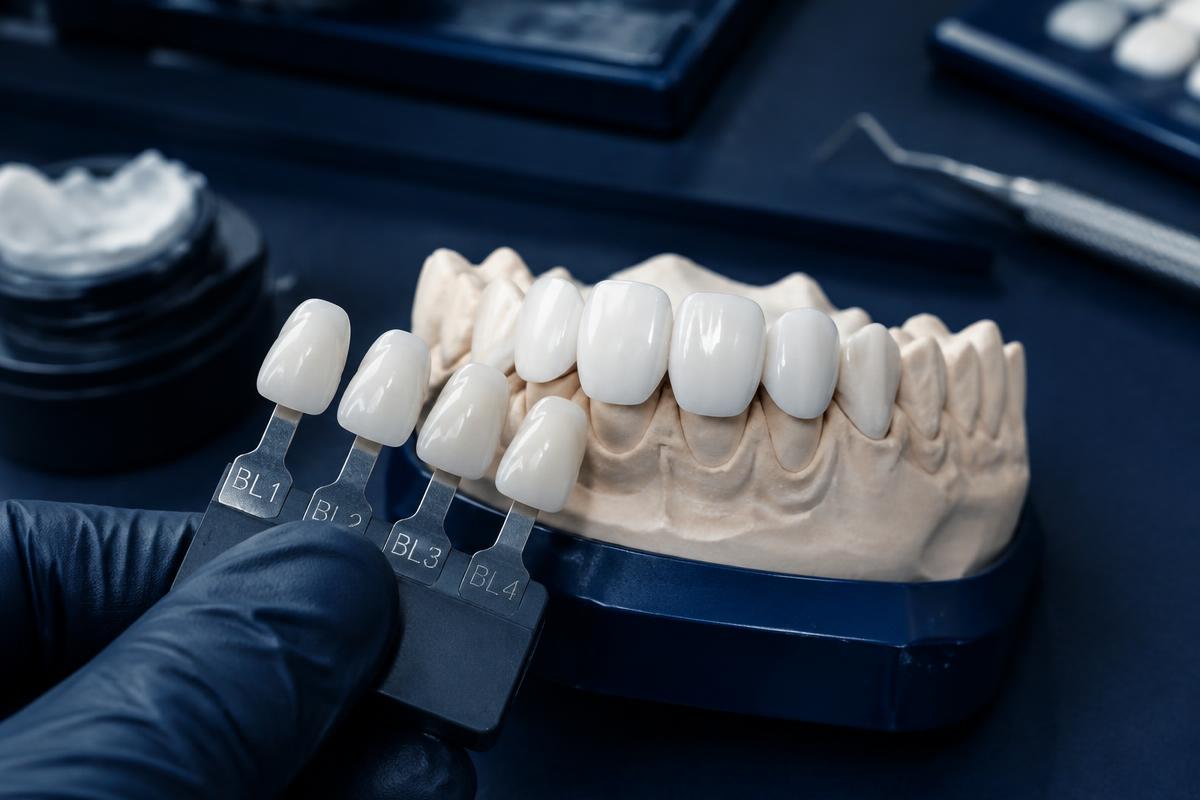
A genuine zirconia veneer is a facial shell covering only the front of the tooth, sometimes wrapping over the incisal edge, with the back left untouched. Zirconia has a clear role in this form. Its high opacity masks discolouration that translucent ceramics cannot, in particular:
- tetracycline staining;
- severe fluorosis;
- dark, root-treated teeth;
- teeth with metal posts.
It is also considerably stronger than feldspathic porcelain or lithium disilicate.
It has two weaknesses as a veneer. Aesthetically, the opacity that masks dark teeth can look flat or chalky on healthy, light teeth, where porcelain or e-max veneers usually look more natural. Adhesively, zirconia cannot be etched with hydrofluoric acid, so bonding a thin veneer with no mechanical retention requires a specific protocol. When clinics skip it and use crown cements, zirconia veneers debond.
For most smile makeovers, porcelain or e-max veneers remain the better choice. Zirconia veneers are a targeted solution for dark substrates, placed by clinicians who know the bonding chemistry.
Why Zirconia Needs a Different Bond
Mechanical retention is how crowns stay on. A crown surrounds the tooth, and its walls grip the preparation through geometry, so conventional cements work well. That is why zirconia crowns can be cemented conventionally.
Chemical adhesion is what a veneer depends on. A veneer sits on the front surface with essentially no retention form, so the bond is the only thing holding it on. Glass-ceramics are etched with hydrofluoric acid, which dissolves their glass phase, and silane then bonds to the silica. Zirconia is a polycrystalline oxide with no glass phase: hydrofluoric acid does not etch it, and silane barely bonds to it.
The solution is the 10-MDP monomer, whose phosphate end bonds chemically to zirconium oxide and whose methacrylate end copolymerises with the resin cement.2 A systematic review and meta-analysis of zirconia adhesion found that bond strength depends significantly on surface conditioning, cement type and ageing, and that combined physical and chemical conditioning gives the most reliable adhesion.1
The tooth side still depends on enamel. Zirconia veneer preparations are usually a little deeper than for thin porcelain laminates, because masking needs thickness and milled zirconia cannot be made as thin at the margins. A typical reduction is 0.5–0.8 mm on the front surface, with margins, and as much of the bonded surface as possible, kept in enamel.
Masking a darkened incisor may need 0.6–1.0 mm of combined ceramic and cement. Where discolouration is extreme, some clinicians first place an opaque resin layer or use internal bleaching. Very dark teeth with large restorations may genuinely be better served by a crown, provided the patient is told clearly that it is a crown.
Zirconia Grades and the APC Protocol
Veneers are usually milled from the more translucent 4Y or 5Y grades, often as multilayer blanks; classic 3Y is too opaque for most veneer work.3 Our guide to zirconia grades explains the differences.
Zirconia veneers are milled oversized in the pre-sintered state, sintered at around 1,450–1,550°C, then stained and glazed. Some are cut back and layered with porcelain for better depth, at the cost of a porcelain–zirconia interface that can chip. Because thin margins are hard to mill, zirconia veneers are rarely thinner than about 0.4 mm.
Bonding follows the APC protocol:
- Air abrasion. The fitting surface is air-abraded with 30–50 µm alumina at low pressure (around 1 bar for thin veneers), cleaning it and increasing bonding area without cracking the ceramic.
- Primer. An MDP-containing primer is applied.
- Cement. The veneer is seated in an MDP-containing resin cement, dual-cured or thoroughly light-cured from several angles, because zirconia transmits less light.
Contamination matters. Saliva and try-in pastes leave phosphate groups on zirconia that block MDP bonding, and phosphoric acid must never be used to clean it. A dedicated zirconia cleaning paste restores the surface after try-in. Our adhesive bonding guide compares protocols for each ceramic.
Treatment Step by Step
Day 1: diagnosis. Photographs, a shade assessment of the underlying teeth, radiographs and an evaluation of each tooth decide the approach. The key question is whether the discolouration needs zirconia, or whether whitening followed by porcelain or e-max would work. A digital design and wax-up follow.
Day 2: mock-up and confirmation. A bis-acryl mock-up shows the planned shape and length. The clinic should confirm in writing that the treatment is a veneer covering the front surface only.
Day 3: preparation. About 0.5–0.8 mm of facial reduction is made through the mock-up, keeping margins in enamel. Dark fillings are masked, a final scan taken and provisionals fitted.
Days 4–7: laboratory work. Veneers are milled, sintered, stained and glazed, or cut back and layered.
Days 7–8: try-in and bonding. Shade is checked with try-in paste. The veneers are then cleaned with zirconia cleaning paste, air-abraded, primed with MDP and bonded with MDP resin cement.
Day 9: review. Bite, gum response and speech are checked, and a night guard is provided if there is grinding.
Veneer or Crown? Reading the Small Print
The first and most important check is whether "veneers" are actually crowns. Ask for the planned preparation depth in millimetres, whether the back and sides of each tooth will be touched, and for photographs of the prepared teeth before bonding. Genuine veneer preparations leave the palatal surface intact.
Next, check the cement. Zirconia veneers bonded with glass ionomer or non-MDP resin cements are at high risk of debonding. Ask the clinic to name its bonding protocol and cement brand, and confirm that air abrasion, an MDP primer and an MDP resin cement are included.
Finally, ask why zirconia at all. On light, healthy teeth, it often looks flatter than porcelain or e-max. Typical Turkish prices sit around £180–£400 per veneer, compared with £700–£1,200 or more in UK practice; very low prices often indicate crowns rather than veneers.
Who It Suits
Zirconia veneers are best reserved for teeth that translucent ceramics cannot mask: severe tetracycline or fluorosis staining that whitening has not corrected, and dark root-treated teeth or teeth with metal posts, provided the facial enamel is sound enough for bonding. On light, healthy teeth, porcelain or e-max veneers usually look more natural. They are also unsuitable where little enamel remains, where gum disease is active, or where crowding needs orthodontics first. The main risks are debonding when an MDP protocol is not used, a flat or chalky look, visible margins, chipping of any layered porcelain, and gum inflammation from overcontoured margins.
When Porcelain Is the Better Choice
Porcelain veneers made from feldspathic ceramic or lithium disilicate etch with hydrofluoric acid and bond reliably with silane and resin. They offer superior translucency and long-term clinical data, and are the standard for most smile makeovers on light or moderately discoloured teeth.
Zirconia veneers are stronger and more opaque, which makes them useful where dark teeth must be masked. The trade-offs are more demanding bonding, less natural translucency and thinner long-term evidence. For thin, minimally invasive options on light teeth, see laminate veneers.
Frequently Asked Questions
Are zirconium veneers the same as zirconium crowns?
No, although they are often marketed as if they were. A veneer covers only the front of the tooth, with about 0.5–0.8 mm of facial reduction, leaving the back and most of the sides untouched. A crown covers the whole tooth and needs 1.0–2.0 mm of reduction all round, removing far more of the tooth. In Turkish, "zirkonyum kaplama" commonly means crowns, which fuels the confusion. Ask for the planned preparation depth, confirmation that the palatal surface will not be touched, and photographs of the prepared teeth.
Why is bonding zirconia harder than bonding porcelain?
Porcelain and lithium disilicate contain a glass phase that hydrofluoric acid dissolves to create micro-retentive pits, and silane then bonds chemically to the silica. Zirconia is a dense polycrystalline oxide with no glass phase, so hydrofluoric acid does not etch it and silane barely bonds to it. For crowns, this matters little, because their walls provide mechanical retention. For veneers, it is critical. The reliable solution is air abrasion, a 10-MDP primer and an MDP resin cement; research shows this combined conditioning gives the most dependable bond.
Can zirconia veneers hide tetracycline stains?
Often, yes; that is the main reason to choose zirconia for veneers. Its opacity blocks the grey, brown or banded discolouration of tetracycline staining far better than translucent porcelain at the same thickness. The result still depends on veneer thickness, zirconia grade, cement shade and sometimes an opaque resin layer or pre-whitening. Very severe staining may need thicker veneers or, occasionally, crowns. Because zirconia is more opaque, the result may look slightly less translucent than natural enamel, so judge it on a mock-up and try-in beforehand.
If a zirconia veneer comes off, can it be re-bonded?
Usually, yes, if the veneer and tooth are undamaged. The dentist removes old cement from both, then restores a clean bonding surface on the zirconia with air abrasion and zirconia cleaning paste. The zirconia is re-primed with MDP primer, the enamel re-etched and bonded, and the veneer seated with an MDP resin cement. It should never be re-cemented with a conventional or temporary cement, which will fail again. If veneers debond repeatedly, the cause may be dentine exposure, contamination or a bite problem, and it needs investigating.
References
- Özcan M, Bernasconi M. Adhesion to zirconia used for dental restorations: a systematic review and meta-analysis. J Adhes Dent. 2015;17(1):7–26. doi:10.3290/j.jad.a33525
- Kern M, Wegner SM. Bonding to zirconia ceramic: adhesion methods and their durability. Dent Mater. 1998;14(1):64–71. PubMed
- Zhang Y, Lawn BR. Novel zirconia materials in dentistry. J Dent Res. 2018;97(2):140–147. PubMed