Dental · Smile Makeover
Hollywood Smile in Turkey: An Ethical Treatment Plan

- Visits
- 1–2 trips, often with aligners or whitening completed at home first
- Days in Turkey
- 7–12 days per trip
- Recovery period
- 2–5 days of mild sensitivity; 1–2 weeks of gum healing after contouring
- Expected lifespan
- Porcelain veneers 15–20+ years; composite bonding 5–7 years; whitening needs periodic top-ups
Want the full picture first?
Read the hub page before comparing single options.
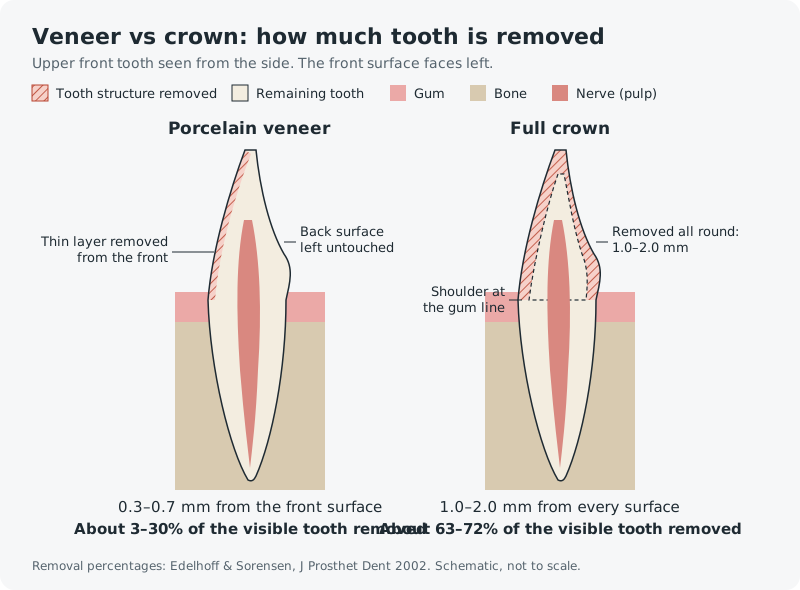
Key facts - A Hollywood smile is not one procedure but a treatment plan, typically combining whitening, gum contouring, composite bonding and a limited number of veneers. - Full crown preparations remove around 63–72% of a front tooth's visible structure; veneers remove roughly 3–30%. - A BBC documentary made with the BDA found one Turkish clinic recommending crowns on all 28 of a dentist's healthy teeth. - A conservative combination of whitening, bonding and 6–10 veneers typically costs £2,000–£5,000 in Turkey.
What a Hollywood Smile Should Mean
"Hollywood smile Turkey" has become shorthand for a particular product: 20 or more bright white crowns placed on young adults over a few days, sold as a flat-rate package. On healthy, previously untreated teeth, this is indefensible overtreatment.
The scale of the problem is documented. In a 2022 British Dental Association survey of 1,000 UK dentists, 86% of those who had examined patients treated abroad reported treating complications, and crowns were the treatment most often needing follow-up.2 In a BBC documentary made with the BDA, a dentist sent photographs of her own healthy teeth to clinics in Turkey; one suggested crowning all 28 of them.3
Laboratory measurements show why this matters. Full crown preparations on front teeth remove around 63–72% of the visible tooth structure, compared with roughly 3–30% for veneers.1 Some crowned vital teeth later need root canal treatment, and every crown will need replacing several times over a lifetime, each time removing more tooth.
An ethical Hollywood smile starts from the opposite question: what is the least invasive way to reach the result you want? Often the answer combines:
- clear aligners for crowding or rotations;
- teeth whitening to brighten every natural tooth;
- composite bonding for small chips, gaps and edges;
- a limited number of porcelain veneers on genuinely discoloured, misshapen or worn teeth;
- crowns only on teeth that are already heavily damaged.
The result can be just as striking as a 20-crown package, while leaving most teeth untouched.
Diagnosing Tooth by Tooth
The plan starts with a tooth-by-tooth diagnosis. For each tooth in the smile, the clinician records pulp vitality, existing restorations, enamel quantity, position and rotation, colour and gum health. Each tooth is then assigned the least invasive treatment that achieves the design. A plan giving every tooth the same treatment has skipped this step.
Preserving biological health underlies every decision:
- enamel is the most reliable bonding surface and cannot regenerate;
- the pulp tolerates shallow preparation well but responds poorly to deep reduction all round;
- the gums must be healthy before treatment and must not be invaded by margins;
- the bite must be stable, with incisal edges and canine guidance designed so restorations are not overloaded.
Gingivoplasty and laser gum contouring reshape the gum frame. Uneven gum heights, or a "gummy" smile caused by excess tissue covering part of the tooth, can be corrected by removing and sculpting gum with a scalpel or laser. Ideally, the gum high points over the central incisors and canines sit slightly higher than over the lateral incisors.
Before cutting, the clinician must measure where the bone sits. If the new gum margin would come within about 3 mm of the bone crest, removing gum alone will fail; the tissue grows back or stays inflamed.4 Surgical crown lengthening, with bone recontouring and 8–12 weeks of healing, is then needed. Our guide to biological width explains why. A gummy smile caused by the jaw's position or an overactive upper lip cannot be fixed by laser contouring alone.
Design Principles and Materials
Smile line curvature. In an attractive smile, the upper incisal edges follow the curve of the lower lip when smiling. A flat or reversed incisal line looks aged or artificial.
Golden proportions (1.618). In the classic golden proportion, each tooth appears about 62% as wide as the one in front of it when viewed from the front. It can be a starting point, but it often makes lateral incisors look too narrow. Many clinicians instead work with a central incisor width-to-length ratio of about 75–80%, adapted to the face.
Shade selection. Natural teeth range from A1 and B1 at the lightest end of the VITA classic guide to darker shades. Bleach shades such as BL1 and BL2 lie beyond anything natural teeth achieve and, on ceramic, often look flat and chalky. A bright but natural result is usually around B1/A1 or the lighter natural bleach shades, judged against skin tone, the whites of the eyes and age.
For veneers, feldspathic porcelain or pressed lithium disilicate gives the most lifelike translucency. Zirconia is reserved for dark, root-treated teeth that need masking, or teeth that genuinely need crowns. Everything is designed from a digital smile design and tested on a mock-up before any tooth is prepared.
What to Expect in Turkey
Before travel. Photographs, video and scans are sent to the clinic. Crowding is often treated with clear aligners over 4–9 months at home. Whitening, at home or in the clinic, sets the shade of the natural teeth.
Day 1: diagnosis and design. Examination, radiographs, tooth-by-tooth assessment, gum probing and bone sounding, followed by the digital design and wax-up.
Day 2: mock-up approval. A resin mock-up shows shape, length, smile line and speech; changes are made until you approve.
Day 3: gum contouring. Laser contouring where needed. If bone recontouring is required, final veneers move to a second trip after 8–12 weeks.
Days 4–5: preparation. Only the planned teeth are prepared, conservatively through the mock-up; bonding is placed on the teeth selected for it. Temporary veneers reproduce the approved design.
Days 6–10: fitting. Veneers are tried in and bonded; bite, speech and gum response are checked, and a night guard is made.
Questions to Ask Before You Book
How many teeth, and which treatment for each? Flat-rate offers such as "Full Hollywood Smile €2,500" often mean 20–28 crowns regardless of age or tooth condition, at around €100–€125 per unit, which rarely buys premium materials. An ethical plan varies between patients; typical Turkish prices for a conservative combination of whitening, bonding and 6–10 veneers sit around £2,000–£5,000.
Veneer or crown, and how deep? "Veneers or crowns – zirconium" tells you nothing about how much of each tooth will be removed. Ask for the preparation type and depth per tooth, the ceramic and the shade, and for photographs of the prepared teeth.
Will the bone be measured before gum contouring? Contouring without probing and bone sounding can leave gum that grows back or stays inflamed. Ask whether crown lengthening might be needed.
Who It Suits
A Hollywood smile plan suits adults with healthy teeth and gums who want a brighter, more harmonious smile, and who are open to orthodontics and whitening before any ceramic work. Veneers or crowns should be reserved for teeth with genuine discolouration, wear, chips, shape defects or failing restorations. It is the wrong path for anyone with untreated decay or gum disease, for heavy grinders without protection, and for young patients being offered full crowns on healthy teeth. Expectations of extreme whiteness are also a warning sign. The risks include sensitivity, pulp damage, gum regrowth or inflammation after contouring, an artificial-looking result, and debonding or chipping.
Where Digital Smile Design Fits
Digital smile design is the planning process, not the treatment. It uses facial photographs, video and scans to design proportions, smile curve and gum outline, and produces a mock-up you approve before any tooth is touched.
A Hollywood smile is the treatment that follows. It should always be built on a documented design; without one, you approve your new teeth only after they have been fitted.
Frequently Asked Questions
Do I need crowns on all my teeth for a Hollywood smile?
Almost certainly not. Crowns are justified only on teeth already heavily damaged, root-treated or extensively restored. Healthy teeth can be brightened with whitening, reshaped with composite bonding, or covered with conservative veneers that leave most of the tooth intact, and crowding is best corrected with aligners first. A typical ethical plan treats 6–10 teeth with veneers or bonding and leaves the rest natural. If a clinic proposes 20 or more crowns on healthy teeth, get an independent second opinion before agreeing.
How white should I go?
Bright but natural. Most people look best around B1 or A1, the lightest natural shades, or the lighter end of the bleach range, with veneers matched to whitened natural teeth. Very high bleach shades such as BL1 and BL2 are whiter than any natural tooth and often look opaque and artificial, especially on ceramic and as your face ages. Choose the shade in natural light, against your skin tone and the whites of your eyes, and view it on a mock-up first. Veneers will not change colour later; your natural teeth may darken slightly.
What is gum contouring, and do I need it?
Gum contouring reshapes the gum line with a laser or scalpel to even out gum heights or expose more of teeth partly covered by gum. It helps when uneven or excess gum makes teeth look short or asymmetric, but it is not needed in every case. Before contouring, the clinician should measure where the bone lies; if the new gum line would sit too close to it, laser contouring alone fails and surgical crown lengthening is needed. Gummy smiles caused by jaw position or lip movement need different treatment.
I'm in my early twenties. Is a Hollywood smile appropriate?
A conservative one can be. Whitening, aligners, bonding and a small number of minimally prepared veneers are all reasonable at this age. Full crowns on healthy teeth are a very different decision: each crown will need replacing roughly every 10–15 years, so a 22-year-old could face four or five remakes over a lifetime, each removing more tooth and moving closer to root canal treatment or implants. Composite bonding, which is effectively reversible, is often the wisest starting point.
References
- Edelhoff D, Sorensen JA. Tooth structure removal associated with various preparation designs for anterior teeth. J Prosthet Dent. 2002;87(5):503–509. doi:10.1067/mpr.2002.124094
- British Dental Association. Survey of 1,000 UK dentists on treatment abroad (July 2022). Reported in Dental Tribune UK. Article
- GDPUK. Dental tourism documentary highlights hidden dangers (BBC/BDA, Turkey Teeth: Bargain Smiles or Big Mistake?). Article
- Jepsen S, Caton JG, Albandar JM, et al. Periodontal manifestations of systemic diseases and developmental and acquired conditions: consensus report of workgroup 3 of the 2017 World Workshop. J Clin Periodontol. 2018;45(Suppl 20):S219–S229. PubMed