Dental · Dental Implants
All-on-8 Dental Implants in Turkey: Why Eight Is Rarely Needed
- Visits
- 2 trips as standard; 3 if grafting is needed first
- Days in Turkey
- 6–8 days on trip one; 6–9 days on trip two
- Recovery period
- 10–14 days of swelling; soft diet for 8–12 weeks during osseointegration
- Expected lifespan
- Implants 15–20+ years; segmented zirconia or porcelain bridges 10–15+ years, each replaceable independently
Want the full picture first?
Read the hub page before comparing single options.
Key facts - All-on-8 restores a full arch with eight implants, usually supporting segmented 3-unit or 4-unit bridges rather than one continuous prosthesis. - International consensus recommends at least four well-distributed implants for a one-piece full-arch bridge; additional implants mainly add the option of segmented bridges. - Eight implants need abundant bone along the whole arch; forcing them into compromised bone, or crowding them closer than 3 mm, can increase failure risk. - Indicative pricing is £7,000–£12,000 per arch in Turkey, against £4,500–£8,500 for All-on-6.
Why Eight Implants Are Rarely Needed
All-on-8 dental implants in Turkey are increasingly advertised as the most secure full-arch option, on the assumption that more implants mean more strength. Beyond six well-positioned implants, that logic has diminishing returns, and in the wrong patient it reverses.
The evidence is clear on the basic point. A systematic review prepared for the ITI found similar implant and prosthesis survival for full-arch bridges on fewer than five implants and on five or more.1 The resulting ITI consensus recommends a minimum of four appropriately distributed implants for a one-piece full-arch bridge, and notes that additional implants provide options for segmented full-arch prostheses.2 In other words, the clinical reason to choose eight implants is to segment the arch, not to make it "stronger".
The legitimate indication is therefore narrow: a broad arch with generous bone volume and density along its whole length, in a patient who wants fixed teeth that look and clean like natural crown-and-bridge work, without pink gum ceramic or heavy bone reduction. Eight implants make it possible to divide the arch into three or four independent bridges, so a problem in one segment can be dealt with without disturbing the rest.
The problem is that the patients who most often need full-arch treatment have lost bone to periodontitis or long-term denture wear. In a resorbed jaw, fitting eight implants means narrow fixtures, crowding or grafting, each of which adds biological risk without adding function. Each implant is also another potential site of peri-implant disease.4 For most full arches, six is the evidence-based default, and four is the default where posterior bone is limited.
Spacing, Biological Width and Rigidity
The first constraint is space. Inter-implant distance should be at least 3 mm; when adjacent implants sit closer, the bone between them resorbs and the papilla collapses.3 Distances to remaining natural teeth should be at least 1.5 mm. With eight implants of about 4 mm diameter across a typical arch, the margin for error is small, which is why ridge width and arch length must be measured precisely on CBCT. Our implant positioning guide sets out these distances.
The second is biological width. Around every implant, a band of soft tissue attachment roughly 3–4 mm deep forms, and the bone remodels to accommodate it. When implants are crowded, adjacent remodelling zones overlap and the thin bone between them can be lost entirely, leaving exposed threads and deep pockets. See our guide to biological width.
The third is bone quality. Pristine bone density along the whole arch is what makes eight implants predictable. In soft upper-jaw bone, adding implants is sometimes argued for to spread load, but poor-quality bone that is also low in volume generally responds better to fewer, longer implants, tilted where necessary, as in All-on-4.
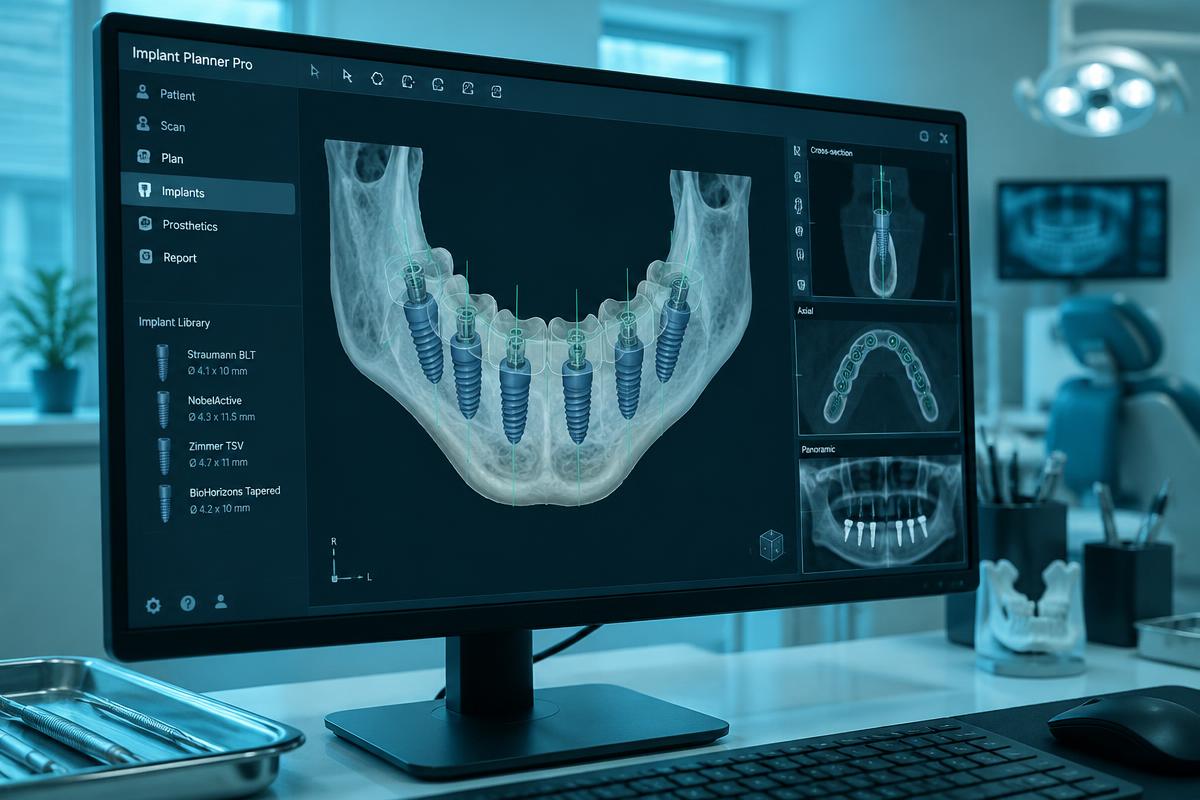
Precise positioning is only achievable with surgical stent planning: a CBCT and intraoral scan merged in planning software, implant positions designed backwards from the final teeth, and a printed guide fixed with anchor pins. Placing eight implants freehand in a full arch is difficult to justify.
Finally, excessive rigidity. The lower jaw flexes slightly on wide opening as the muscles pull the two sides inward. A single rigid bridge across eight lower implants resists that flexure and transfers the stress to implants and screws. This is a key reason All-on-8 is usually segmented.
Segmented Bridges and Hygiene Design
The typical definitive design is a set of 3-unit or 4-unit segmented bridges, each on two implants. A common upper-jaw layout is four segments:
- two anterior bridges from central incisor to canine;
- two posterior bridges from the premolars to the first molar.
In the lower jaw, the arch is often split at the midline or the canines so the bridges can move with mandibular flexure.
Each segment is usually screw-retained, in monolithic zirconia or layered zirconia on titanium bases. Screw retention avoids excess cement below the gum, a well-documented cause of peri-implant disease. Monolithic 3Y or 4Y zirconia is strongest in the molar region; multilayer 5Y gives better translucency at the front.
Because the aim is teeth that appear to emerge naturally from the gum, the laboratory designs the emergence profile of each unit to support the soft tissue without compressing it, while leaving open embrasures wide enough for interdental brushes. Hygiene access must be designed at the wax-up stage; it cannot be added afterwards.
Guided Surgery to Final Segments
Day 1: consultation and planning. CBCT and intraoral scans are merged, and a digital smile design and implant plan show whether eight implants can respect the 3 mm spacing and biological width. If they cannot, a responsible clinic recommends six.
Day 2 or 3: guided surgery. Extractions and placement of eight implants through the surgical guide, with torque recorded, under IV sedation.
Days 3–5: provisional. A one-piece PMMA provisional splints all eight implants. At this stage rigidity is protective, limiting micromovement while bone integrates.
Days 6–8: review. Healing is checked, and hygiene is taught with interdental brushes and a water flosser.
Months 3–6: second trip. Stability is assessed and each segment scanned. A try-in confirms emergence profiles and hygiene access, then the segmented bridges are fitted. A night guard is essential if you clench or grind.
Spotting Over-Servicing
Per-implant fees. Many clinics price per implant, so eight generate more revenue than six whether or not they are needed. If a clinic recommends eight without explaining, on your CBCT, why six would not suffice, get a second opinion. Indicative pricing is £7,000–£12,000 per arch for All-on-8, against £4,500–£8,500 for All-on-6.
Eight implants under a one-piece bridge. Some quotes put eight implants under a single continuous zirconia or acrylic bridge. That takes on the cost and biological risk of eight implants without the main benefit, segmentation. Ask how many separate segments the definitive work will have.
Grafting to fit the number. If your jaw needs grafting to accommodate eight implants when six would fit without it, the plan is being driven by implant count rather than need. Grafts, sinus lifts and narrow implants should appear in writing with a clinical justification.
Candidacy
Ideal candidates
- A broad arch with abundant bone volume and density along its full length.
- Patients who want fixed teeth resembling natural crown-and-bridge work, without pink gum ceramic.
- Non-smokers with excellent oral hygiene who will use interdental brushes daily.
Contraindications & complications
- Significant bone resorption, narrow ridges, or an arch too short for 3 mm spacing.
- Uncontrolled diabetes, heavy smoking, a history of aggressive periodontitis, IV bisphosphonates or radiotherapy to the jaw.
- Complications include crestal bone loss between crowded implants, peri-implant disease at multiple sites, screw loosening, and stress transferred through overly rigid one-piece designs.
If Eight Implants Aren't Justified
All-on-6 already provides shortened cantilevers, good load distribution and survival of the bridge if one implant fails. For most full arches, six implants balance strength, cost and hygiene best.
All-on-8 adds real value only with abundant bone and a plan to segment the arch into independent 3-unit or 4-unit bridges, for patients who prioritise retrievability and a natural crown-and-bridge appearance. Where bone is compromised, the extra implants add risk rather than safety. For a smaller number of missing teeth, see multiple implants.
Frequently Asked Questions
Are eight implants stronger than six?
Not in any clinically meaningful sense once six implants are well positioned with a good A–P spread. Systematic reviews show no significant survival advantage for more implants per arch, and international consensus treats four well-distributed implants as the minimum for a one-piece bridge. What eight implants actually add is the option to segment the arch into independent bridges. The cost is more surgery, more expense and more sites that can develop peri-implant disease. If the extra implants force narrower diameters, closer spacing or grafting, overall reliability can fall.
Why does the 3 mm spacing rule matter so much?
When two implants are closer than about 3 mm, their zones of bone remodelling overlap, the bone between them resorbs, and the gum papilla collapses, leaving a dark triangle or food trap. More importantly, losing that thin bony wall exposes implant threads to bacteria, which are much harder to clean and to treat once peri-implantitis starts. In All-on-8, with eight fixtures sharing a limited arch length, this rule is the main factor deciding whether the plan is biologically sound. Ask the clinic to show you the measured spacing on your digital plan.
Why are All-on-8 bridges usually segmented?
Segmentation is the main reason to choose eight implants. Separate 3-unit or 4-unit bridges fit more passively than one long span, reducing stress on implants and screws, and they accommodate the slight flexing of the lower jaw on opening instead of resisting it. A problem in one segment, such as a fractured crown or an implant with bone loss, can be dealt with by removing that segment alone. Segments are also easier to clean, with open embrasures that resemble natural teeth. A one-piece bridge on eight implants gives up these advantages while keeping the extra cost.
How can I tell if a clinic is over-servicing me?
Ask the clinic to explain, using your CBCT, why eight implants are necessary and six are not. A genuine indication involves abundant bone, a broad arch, a segmented bridge design and a clear aesthetic or retrievability goal. Warning signs include per-implant pricing without clinical justification, eight implants under a one-piece bridge, grafting proposed simply to make room for more implants, and reluctance to share the digital plan. An independent second opinion from a prosthodontist, based on your CBCT files, costs little compared with the difference between six and eight implants.
References
- Polido WD, Aghaloo T, Emmett TW, Taylor TD, Morton D. Number of implants placed for complete-arch fixed prostheses: a systematic review and meta-analysis. Clin Oral Implants Res. 2018;29(Suppl 16):154–183. doi:10.1111/clr.13312
- Morton D, Gallucci G, Lin WS, et al. Group 2 ITI Consensus Report: Prosthodontics and implant dentistry. Clin Oral Implants Res. 2018;29(Suppl 16):215–223. PubMed
- Tarnow DP, Cho SC, Wallace SS. The effect of inter-implant distance on the height of inter-implant bone crest. J Periodontol. 2000;71(4):546–549. PubMed
- Derks J, Tomasi C. Peri-implant health and disease. A systematic review of current epidemiology. J Clin Periodontol. 2015;42(Suppl 16):S158–S171. PubMed