Dental · Dental Implants
All-on-4 Dental Implants in Turkey: What Four Implants Can and Cannot Do
Want the full picture first?
Read the hub page before comparing single options.
Key facts - All-on-4 replaces a full arch with a fixed bridge on four implants; the two back implants are tilted to avoid the sinus or nerve, often removing the need for bone grafting. - The developers' long-term studies report implant survival of about 95% over up to 13 years in the upper jaw, but around a third of final bridges had mechanical complications over up to 18 years in the lower jaw. - A systematic review found no significant difference in survival between fewer than five and five or more implants per arch. - Tilted implants performed as well as straight ones overall in a large meta-analysis, but showed higher failure rates when only upper-jaw studies were pooled. - Headline prices of £3,500–£5,000 are usually per arch with an acrylic bridge; both arches typically cost £7,000–£14,000 in Turkey.
What All-on-4 Actually Solves
All-on-4 dental implants in Turkey are usually marketed as a budget version of full-mouth implants. That is clinically misleading. The concept was developed for edentulous or failing arches where bone has resorbed so far that vertical implants in the back of the jaw would need sinus augmentation or nerve repositioning. It does not exist to save the cost of two implants; it exists so that a patient with limited bone can have fixed teeth without a year of grafting.
The evidence on implant numbers supports this. A systematic review prepared for the International Team for Implantology found similar survival for full-arch bridges on fewer than five implants and on five or more,3 and the ITI consensus recommends a minimum of four well-distributed implants for a one-piece full-arch bridge.5
The long-term data are encouraging but should be read carefully. The developers' clinic reported, in 471 lower-jaw patients followed for up to 18 years, predictable implant outcomes, but mechanical complications in 29.5% of provisional bridges and 36.7% of final bridges.1 In the upper jaw, among 1,072 patients followed for up to 13 years, implant survival was 94.7%.2 These studies come largely from the clinic that developed the concept, so independent long-term data remain important.
What social media leaves out is that the "new smile in a day" is a provisional acrylic bridge worn for three to six months while bone fuses to the implants, and that bone is often deliberately reduced to create space for the prosthesis. Four implants are an engineering answer to a specific anatomical problem, and should be prescribed as one.
Tilted Implants, Bone and Cantilevers
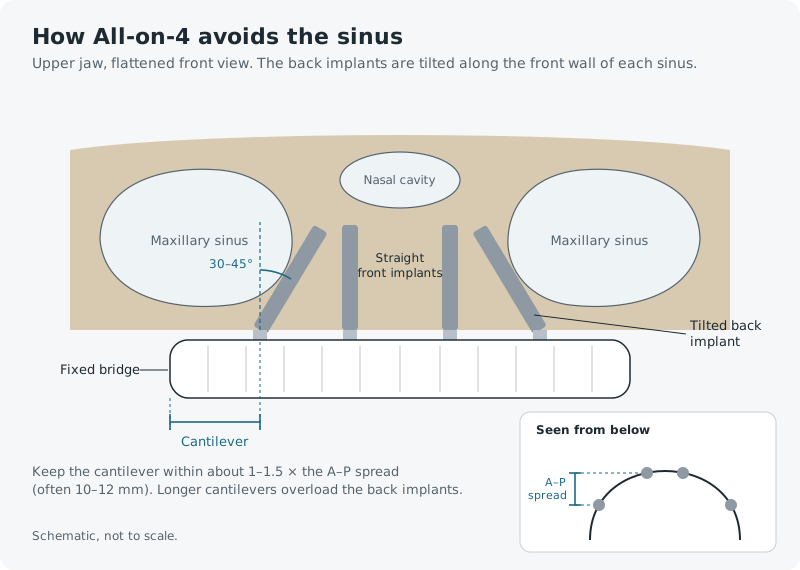
The two anterior implants are placed axially in the anterior bone volume, the dense bone between the canines, which usually survives when the back of the jaw has resorbed. The two distal implants are tilted at 30–45 degrees.
In the upper jaw, the tilted implants run along the front wall of the maxillary sinus, a sinus bypass that avoids a sinus lift. In the lower jaw, they are placed just in front of the mental foramen and angled backwards to clear the nerve. Tilting allows longer implants with better bone engagement, moves the implant heads back to the second premolar or first molar position, and widens the anterior–posterior (A–P) spread. Angled multi-unit abutments (17° or 30°) bring the screw channels back to a common path.
A large meta-analysis found no overall difference in failure rates between tilted and axial implants. However, when only upper-jaw studies were pooled, tilted implants showed a significantly higher failure rate.4 That is one reason careful planning matters more in the maxilla.
A wider A–P spread limits cantilever length, the part of the bridge extending unsupported behind the last implant. A common guideline keeps the cantilever within 1–1.5 times the A–P spread, typically around 10–12 mm. In heavy chewers and bruxists, a long cantilever acts as a lever, concentrating stress on the distal implant, loosening screws and fracturing prostheses. This is the real weakness of four implants.
Cross-arch stabilisation makes immediate loading possible: the rigid, splinted bridge spreads forces across all four fixtures, keeping micromovement below the level that disrupts osseointegration. Immediate loading is only justified if each implant reaches an insertion torque of around 35–45 Ncm; otherwise the protocol should change.
Alveoloplasty often levels the ridge, creating roughly 12–15 mm of restorative space and placing the junction between gum and prosthesis above the smile line.
Provisional and Final Bridges
The PMMA acrylic provisional is milled or processed from a pre-surgical design and screwed onto multi-unit abutments within 24–72 hours. It is deliberately light, with a shortened or no cantilever and 10–12 teeth, and its slight flexibility cushions load during integration. Our guide to temporary crowns explains why milled PMMA is preferred for provisionals worn for months.
The definitive options behave differently over time:
- Titanium-reinforced acrylic or composite hybrids are cheaper and easy to repair, but the teeth wear and stain and usually need renewing within 5–8 years.
- A screw-retained multi-unit zirconia bridge is the durable option, milled from 3Y or multilayer 4Y/5Y zirconia (see zirconia grades), sintered and bonded to titanium bases. Reputable labs name the blank manufacturer.
- Monolithic zirconia avoids chipping but must be carefully adjusted, as it is very hard against the opposing arch.
- Layered porcelain on zirconia looks more natural but chips more often on full-arch spans.
The fitting surface must be convex and polished so that superfloss and a water flosser can reach underneath. Concave designs trap food and lead to peri-implant inflammation.
Two Trips, Step by Step
Day 1: consultation and imaging. A CBCT maps bone height, sinus anatomy and nerve position. Intraoral scans and facial photographs are used to design the smile, ideally with a surgical guide planned from the data. The implant system should be named in writing (see endosteal implants for how to verify it).
Day 2: surgery. Usually under local anaesthetic with IV sedation: extractions, alveoloplasty, placement of four implants, torque verification and multi-unit abutments, with a same-day scan.
Days 3–4: provisional fitting. The PMMA bridge is fitted with the cantilevers kept out of contact.
Days 5–7: review. Healing and hygiene are checked, and most patients fly home.
Months 3–6: second trip. Implants are checked, ideally with ISQ readings and X-rays. Definitive impressions are verified with a jig, a try-in confirms tooth position, speech and bite height, and the final bridge is torqued to the manufacturer's value. A night guard is made where bruxism is suspected.
Reading an All-on-4 Quote
Single-arch pricing presented as full mouth. A headline of £3,500–£5,000 almost always covers one jaw. Upper and lower together typically cost £7,000–£14,000 in Turkey, depending on materials. Ask for per-arch pricing in writing.
"Teeth in a day" meaning temporary teeth. Some quotes cover only the PMMA provisional; the final zirconia bridge can add £1,500–£3,500 per arch. Confirm the quote names the definitive prosthesis and includes the second trip's clinical fees.
Vague component lists. Extractions, CBCT, sedation, grafting, multi-unit abutments and the night guard are often omitted. A good quote names the implant system and abutment brand, promises batch stickers, and sets out what happens if an implant fails to integrate.
Candidacy
Ideal candidates
- Edentulous patients, or patients with failing teeth, who have adequate anterior bone but limited bone at the back.
- Non-smokers or light smokers with good glycaemic control (HbA1c below about 7%).
- Patients with moderate bite forces and a commitment to daily cleaning under the bridge.
Contraindications & complications
- Uncontrolled diabetes, heavy smoking, IV bisphosphonates or denosumab, and radiotherapy to the jaw.
- Severe bruxism or a short A–P spread, both of which favour more implants.
- Complications include fracture of acrylic teeth, screw loosening, peri-implantitis, air escape affecting speech in the upper arch, and food trapping.
How All-on-4 Compares With All-on-6
All-on-6 adds two implants at the back, shortening or eliminating cantilevers and building in redundancy: if one implant fails, the bridge usually survives. It suits heavy chewers and patients with good posterior bone.
All-on-4 is the better option when posterior bone is insufficient and the alternative would be sinus lifts or nerve procedures. Where even tilted implants have nothing to engage, zygomatic implants anchored in the cheekbone are the next option. All-on-8 is rarely needed. If your bite height also needs rebuilding, the plan becomes a full mouth reconstruction. The choice should come from the CBCT, not the price.
Frequently Asked Questions
Is All-on-4 less reliable than All-on-6?
Not inherently. Systematic reviews show no significant survival difference between fewer than five and five or more implants per arch, and long-term All-on-4 studies report implant survival around 95% over a decade or more. The difference lies in the margin for error: with four implants, losing one usually means remaking the bridge, whereas six typically tolerate a single failure. Case selection also matters. A patient with good A–P spread, moderate bite forces and short cantilevers does very well on four; a heavy bruxist with long cantilevers is at much greater risk of mechanical problems.
Why do I need two trips if the teeth are fitted in days?
The teeth fitted on your first trip are a PMMA provisional, designed to protect the implants during osseointegration, which takes about three to six months. During that time your gums shrink and the ridge remodels, so a definitive bridge made on day three would not fit well months later. The second trip allows fresh impressions on healed tissue, verification of implant stability, and a try-in to refine your bite, speech and appearance. Keeping the temporary indefinitely risks acrylic fracture, poor hygiene access and an unstable bite.
What happens if an implant does not reach 35 Ncm torque?
Immediate loading relies on primary stability. If an implant inserts below the threshold, the surgeon can replace it with a wider or longer fixture, reposition it, add a fifth implant, or abandon immediate loading for that arch, in which case you wear a relined denture while the implants integrate unloaded. A reputable clinic explains this possibility before surgery and records each implant's insertion torque in your notes. Loading an implant with poor primary stability to keep to a travel schedule is a common and avoidable cause of early failure.
Can problems be managed back in the UK, EU or US?
Often, provided you have full documentation: the implant system and batch numbers, multi-unit abutment brand and angulation, screw torque values, CBCT files and the laboratory design data. Many UK practitioners will service major implant systems but are reluctant to work on unfamiliar or unbranded components, and local fees for removing a bridge or treating peri-implantitis can be substantial. Before committing, ask what the warranty covers, whether the clinic pays for remedial work abroad, and whether its implant system has wide international component availability.
Can I have All-on-4 if I grind my teeth?
Often, but with extra care. Grinding concentrates force on the distal implants and the cantilevered back teeth, which is where All-on-4 is most vulnerable. A careful plan keeps cantilevers short, uses a strong framework, often titanium-reinforced or monolithic zirconia, and adjusts the bite so the back teeth do not take heavy side-to-side contact. You should wear a hard night guard every night once the final bridge is fitted. If grinding is severe and posterior bone allows it, six implants may be the safer choice, because they shorten the cantilevers and add redundancy.
References
- Maló P, de Araújo Nobre M, et al. The All-on-4 treatment concept for the rehabilitation of the completely edentulous mandible: a longitudinal study with 10 to 18 years of follow-up. Clin Implant Dent Relat Res. 2019;21(4):565–577. PubMed
- Maló P, de Araújo Nobre M, et al. The All-on-4 concept for full-arch rehabilitation of the edentulous maxillae: a longitudinal study with 5–13 years of follow-up. Clin Implant Dent Relat Res. 2019;21(4):538–549. PubMed
- Polido WD, Aghaloo T, Emmett TW, Taylor TD, Morton D. Number of implants placed for complete-arch fixed prostheses: a systematic review and meta-analysis. Clin Oral Implants Res. 2018;29(Suppl 16):154–183. doi:10.1111/clr.13312
- Chrcanovic BR, Albrektsson T, Wennerberg A. Tilted versus axially placed dental implants: a meta-analysis. J Dent. 2015;43(2):149–170. doi:10.1016/j.jdent.2014.09.002
- Morton D, Gallucci G, Lin WS, et al. Group 2 ITI Consensus Report: Prosthodontics and implant dentistry. Clin Oral Implants Res. 2018;29(Suppl 16):215–223. PubMed