Dental · Dental Implants
All-on-6 Dental Implants in Turkey: When Six Implants Are Worth It
- Visits
- 2 trips as standard; 3 if a staged sinus lift or block graft is needed
- Days in Turkey
- 6–8 days on trip one; 5–8 days on trip two
- Recovery period
- 7–14 days of swelling; soft diet for 8–12 weeks; 4–9 months of healing if grafted
- Expected lifespan
- Implants 15–20+ years; zirconia bridge 10–15+ years
Want the full picture first?
Read the hub page before comparing single options.
Key facts - All-on-6 replaces a full arch with a fixed bridge on six implants, shortening cantilevers and spreading chewing forces. - Its main advantage is redundancy: if one implant fails over the years, the bridge can usually be kept in service. - Survival is similar to four-implant designs in systematic reviews, so six is justified by bite force, arch size or posterior bone, not by default. - In a systematic review, lateral sinus lifts reached 98.3% implant survival at three years with rough-surface implants and a membrane over the window. - Expect £4,500–£8,500 per arch in Turkey before grafting; a lateral sinus lift can add £500–£1,000 per side.
When Six Implants Are Worth It
All-on-6 dental implants in Turkey are often sold as the premium upgrade to All-on-4, as if more implants were automatically better. The evidence does not support that. A systematic review prepared for the ITI found similar survival for full-arch bridges on fewer than five implants and on five or more, in both jaws.1,4
The real differences are in biomechanics and in what happens when something goes wrong. Six implants spread chewing forces over more fixtures and allow the bridge to reach the first molar with little or no cantilever. Most importantly, mechanical redundancy: over ten years, some implant loss is a realistic possibility. With six implants, the bridge can usually be modified and kept. With four, losing one typically means removing the bridge, placing a new implant and remaking the prosthesis.
The trade-off is that six implants need bone in the premolar and molar regions, which is exactly where bone is most often lost. In the upper jaw that often means a maxillary sinus lift; in the lower jaw, enough height above the nerve. Six is clinically justified with:
- high bite forces or bruxism;
- a long arch or strong musculature;
- good posterior bone.
It is not justified when it simply creates a grafting bill that a well-planned All-on-4 would have avoided.
Load Distribution and Posterior Bone
The six implants usually sit at three positions on each side:
- two in the lateral incisor or canine region;
- two in the premolar region;
- two at the first molar, axial or slightly tilted.
This layout gives a wide A–P spread and a shortened cantilever, often under 5 mm or none at all. Molar bite forces in healthy adults commonly reach several hundred newtons, and far more in bruxists. Spreading that masticatory force distribution across six fixtures lowers the stress on each implant–bone interface and each prosthetic screw. The spacing and depth rules are set out in our implant positioning guide.
Posterior bone requirements decide whether the layout is possible. In the lower jaw, posterior implants need roughly 10 mm of bone above the nerve canal, with a safety margin, and a ridge at least 5–6 mm wide. In the upper jaw, sinus expansion often leaves only 3–6 mm under the sinus floor:
- Crestal (transalveolar) sinus lift works with roughly 5–8 mm of residual bone and is often done with implant placement. A systematic review reported 92.8% implant survival at three years.3
- Lateral window sinus lift is needed with less bone. The membrane is lifted through a window in the sinus wall and grafted; implants go in at the same time or 6–9 months later. A systematic review found 90.1% implant survival at three years overall, rising to 98.3% with rough-surface implants and a membrane over the window.2
Horizontal deficits call for bone grafting:
- Particulate grafts (xenograft, allograft or autogenous chips with a membrane) suit contained or moderate defects.
- Block grafts (autogenous bone or allogenic blocks fixed with screws) are used for severe width loss and need 4–6 months before implants.
Immediate loading is still possible with adequate insertion torque, but grafted sites are often left unloaded until healed. Where grafting would be extensive, zygomatic implants or a tilted All-on-4 layout may be more sensible.
Frameworks and Hybrid Bridges
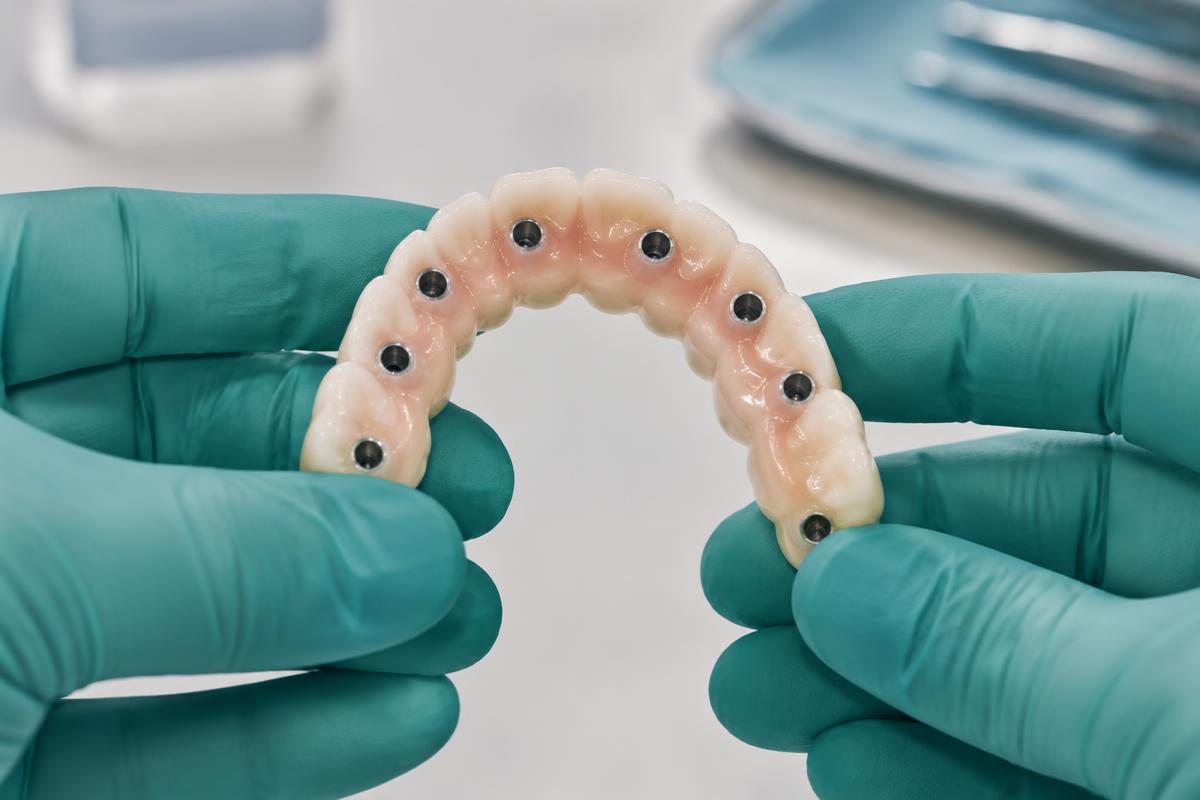
Definitive All-on-6 bridges are screw-retained, allowing removal for maintenance.
Titanium framework with overlay. A CAD/CAM-milled titanium framework carries individual zirconia crowns or composite/acrylic teeth. It is rigid and fits accurately across the arch, and single crowns can be replaced without remaking the whole prosthesis, which is a real advantage over many years.
Screw-retained zirconia hybrid bridge. A single milled zirconia structure bonded to titanium bases, usually multilayer 4Y/5Y for appearance or 3Y where strength matters most (see zirconia grades). It resists staining and wear but is unforgiving: poor passive fit or overload transmits stress straight to the implants, and connectors need adequate cross-section to resist fracture.
With six implants, the lab can also split the arch into two or three segments, which improves passive fit and makes managing a single failed implant easier, at some loss of cross-arch splinting. For a fully segmented design, see All-on-8.
Whatever the design, the fitting surface must be convex and polished. Six implants mean more emergence points to clean, so hygiene access matters even more than with four.
Grafting, Surgery and the Final Bridge
Day 1: consultation and imaging. A CBCT measures posterior bone, the sinus floor and the nerve canal. The clinic should state before surgery whether grafting is needed. Scans and photos are used to plan the smile digitally, and the implant system should be named in writing (see endosteal implants, which also explains how to verify that a brand is genuine and certified).
If a staged graft is needed. A lateral sinus lift or block graft is done on the first trip, and you return after 4–9 months for implants.
Day 2: surgery. Extractions, ridge contouring and placement of six implants, usually with IV sedation, with insertion torque recorded and multi-unit abutments fitted.
Days 3–5: provisional. A PMMA provisional is fitted with the bite kept light.
Flying after a sinus lift. Cabin pressure changes can disrupt a freshly lifted sinus membrane. Many surgeons advise waiting 7–10 days before flying, and avoiding nose-blowing and sneezing with the mouth closed.
Months 3–6: second trip. Stability is checked, impressions verified with a jig, the framework tried in, and the final bridge fitted with a night guard if needed.
Costs Missing From Online Quotes
Missing sinus lift and graft costs. Online quotes are often issued from photos or an old panoramic X-ray, before anyone has seen a CBCT, so the grafting cost appears only in Turkey. A lateral sinus lift can add £500–£1,000 per side, and block grafting more. Ask for a written CBCT review before travel, with conditional grafting prices.
Generic or uncertified implant brands. A low quote may reflect implants without CE, UKCA or FDA clearance, or brands whose parts are unavailable outside Turkey. Ask for the brand, product line, certification and batch stickers.
Unspecified prosthesis. "Zirconia bridge" may not say whether it uses titanium bases or a titanium framework, or whether the second trip's fees are included. Indicative pricing is £4,500–£8,500 per arch before grafting, with both arches roughly double.
Candidacy
Ideal candidates
- Patients with adequate posterior bone, or who accept grafting, and want maximum long-term redundancy.
- Heavy chewers, bruxists, and patients with large arches or strong musculature.
- Non-smokers or light smokers with controlled diabetes and good hygiene.
Contraindications & complications
- Uncontrolled diabetes, heavy smoking, IV bisphosphonates or denosumab, radiotherapy to the jaw, and active sinusitis where a sinus lift is planned.
- Grafting complications include sinus membrane perforation, graft infection and graft resorption.
- General complications include peri-implantitis, screw loosening, zirconia fracture at thin connectors, and hygiene difficulty around extra implants.
Choosing Between Six and Four Implants
All-on-4 tilts the back implants to bypass the sinus or nerve, avoiding grafting and reducing cost and treatment time. It is the rational choice when posterior bone is limited and bite forces are moderate, but it depends on all four implants surviving.
All-on-6 needs more bone, often with grafting, in return for shorter cantilevers, better force distribution and survival of the bridge if one implant fails. If the CBCT shows good posterior bone, or you clench heavily, six is worth the extra cost. If six would require extensive grafting, a well-planned All-on-4 is often better.
Frequently Asked Questions
If one of six implants fails, do I lose the whole bridge?
Usually not. With five implants remaining, there is generally still enough support and A–P spread to keep the bridge in service. The failed implant is removed, its connection on the bridge is sealed or modified, and a replacement can be placed later if bone allows. The bridge may need adjustment, but rarely remaking. This redundancy is the strongest argument for six implants over a ten-year horizon. With four, losing one usually means removing the bridge, replacing the implant and remaking the prosthesis.
Do I definitely need a sinus lift for upper All-on-6?
Not always. It depends on how much bone remains under the sinus in the premolar and first molar region, which only a CBCT can show. With 8 mm or more, standard implants may fit without grafting. With roughly 5–8 mm, a crestal sinus lift can often be done at the same time as placement. With less, a lateral window lift is usually needed, sometimes staged. An alternative is to place the back implants at the second premolar and tilt them, a hybrid layout that can avoid grafting altogether. Ask for these options before committing.
Is a titanium framework better than full zirconia?
Each has advantages. A titanium framework with individual zirconia crowns is rigid, fits accurately across the arch, and allows single crowns to be replaced if they chip, which simplifies long-term maintenance. A full monolithic zirconia bridge resists wear and staining and has fewer components, but a fracture usually means remaking the whole structure, and it demands excellent passive fit because zirconia does not flex. For heavy bruxists and long-term serviceability, many prosthodontists favour titanium frameworks; for appearance and simplicity with moderate bite forces, monolithic zirconia performs well.
References
- Polido WD, Aghaloo T, Emmett TW, Taylor TD, Morton D. Number of implants placed for complete-arch fixed prostheses: a systematic review and meta-analysis. Clin Oral Implants Res. 2018;29(Suppl 16):154–183. doi:10.1111/clr.13312
- Pjetursson BE, Tan WC, Zwahlen M, Lang NP. A systematic review of the success of sinus floor elevation and survival of implants inserted in combination with sinus floor elevation. Part I: lateral approach. J Clin Periodontol. 2008;35(8 Suppl):216–240. doi:10.1111/j.1600-051X.2008.01272.x
- Tan WC, Lang NP, Zwahlen M, Pjetursson BE. A systematic review of the success of sinus floor elevation and survival of implants inserted in combination with sinus floor elevation. Part II: transalveolar technique. J Clin Periodontol. 2008;35(8 Suppl):241–254. doi:10.1111/j.1600-051X.2008.01273.x
- Morton D, Gallucci G, Lin WS, et al. Group 2 ITI Consensus Report: Prosthodontics and implant dentistry. Clin Oral Implants Res. 2018;29(Suppl 16):215–223. PubMed