Dental · Dental Implants
Zygomatic Dental Implants in Turkey: Anchoring Teeth in the Cheekbone
Want the full picture first?
Read the hub page before comparing single options.
Key facts - Zygomatic implants are long implants, typically 30–55 mm, anchored in the cheekbone to support fixed teeth when the upper jaw has resorbed too far for conventional or tilted implants. - A long-term meta-analysis reported mean zygomatic implant survival of 96.2% at around six years, with prosthesis survival of about 94%. - Sinusitis is the most common complication, at about 14% overall in an ITI consensus report; it is less frequent with extra-sinus approaches but reached 12% in quad zygoma cases. - Immediate loading was associated with higher survival than delayed loading in a long-term meta-analysis. - This is hospital-grade maxillofacial surgery; expect £9,000–£16,000 per arch in Turkey, against £25,000–£35,000 or more in the UK.
When the Cheekbone Becomes the Anchor
Zygomatic dental implants in Turkey are advertised as "fixed teeth for people told they have no bone". For the right patient, that claim is justified. A long-term systematic review and meta-analysis reported mean zygomatic implant survival of 96.2% at around six years, with prosthesis survival of about 94%, comparable to conventional implants. Immediate loading actually showed better survival than delayed loading.1 Patients leave with fixed provisional teeth rather than facing a year of grafting.
The procedure's reputation depends on who performs it and where. A zygomatic implant is drilled from inside the mouth, past or through the maxillary sinus, into the body of the cheekbone, a few millimetres from the orbit, the infraorbital nerve and the infratemporal fossa. A systematic review of complications listed labial laceration, orbital cavity penetration, haematoma, nosebleeds, sinusitis, infection and oroantral communication among the most common adverse events.3 Correctly placed, the results are excellent; misplaced, the consequences can be serious and difficult to reverse.
Zygomatic implants are not a premium version of All-on-4. They are indicated when:
- the upper jaw has resorbed so far that even tilted implants cannot find adequate bone;
- previous sinus grafts or implants have failed;
- part of the maxilla has been lost to tumour surgery or trauma.
A patient with enough bone for All-on-4 does not need zygomatic implants.
Anchorage, Surgical Paths and Sinus Health
In severe maxillary resorption, only a few millimetres of bone may remain below the nose and sinuses, and the bone behind the canines can be too thin even for tilted implants. The zygoma, however, remains dense. Zygomatic arch anchorage, more precisely anchorage in the body of the cheekbone, gives the implant thick cortical bone at its tip, while its neck is supported in the residual ridge. That two-point anchorage over a long distance gives the primary stability needed for immediate loading.
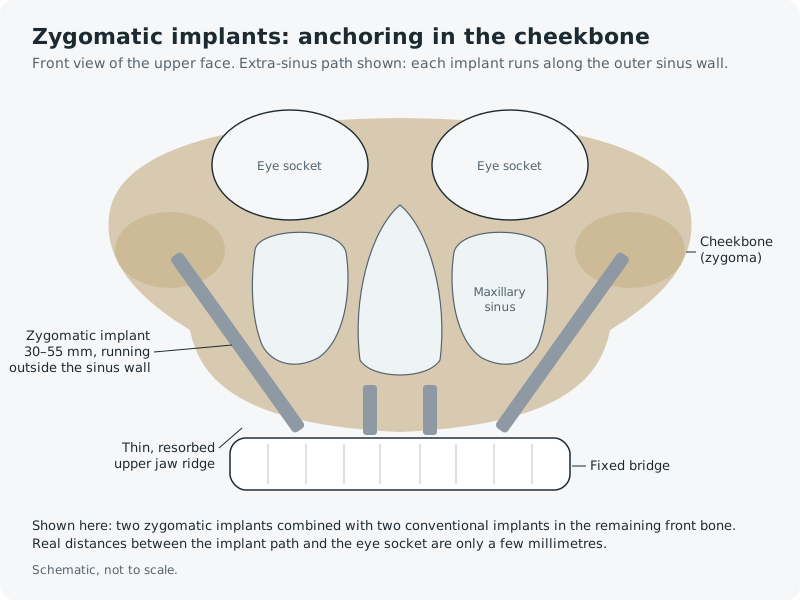
Standard implant lengths run from about 30 mm to 52.5 mm, with some systems longer, emerging at the premolar or first molar region. There are two common configurations:
- two zygomatic implants with two to four conventional implants at the front, where the anterior maxilla still has usable bone;
- quad zygoma, two zygomatic implants on each side, where the anterior bone has also resorbed. A meta-analysis of quad zygoma cases found 98% implant survival but pooled sinusitis of 12%, alongside implant malposition and local infection, so complications should not be underestimated.2
In every configuration, all implants are splinted together by a rigid provisional bridge within 24–72 hours; a zygomatic implant is never loaded alone.
The surgical path has evolved:
- Intra-sinus approach. The original technique passed through a window in the sinus and emerged on the palate, making the bridge bulky and hard to clean.
- Extra-sinus approach. Modern techniques follow the curvature of the maxillary wall, guided by anatomy-based classifications such as the zygoma anatomy-guided approach (ZAGA). The implant runs along or outside the sinus wall and emerges at the ridge crest. A systematic review found less sinusitis with the extra-sinus approach.3 The trade-off is that the implant body lies close beneath the soft tissue, where the gum can break down over it.
An ITI consensus report put the overall prevalence of sinusitis at about 14% over roughly five and a half years of follow-up, making it the most common complication.4 Sinus health clearance is therefore essential. A congested or chronically infected sinus puts both implant and patient at risk, so the CBCT must show clear, draining sinuses, and any sinusitis must be treated, sometimes with ENT surgery, before implants are placed.
Implant Design and the Bridge
Zygomatic implants are usually made from commercially pure titanium, often with a rough apex for integration in the cheekbone and a smooth or machined body where the implant lies against the sinus membrane or under the gum, which a rough surface would make harder to keep clean. Angled heads connect to multi-unit abutments that correct the steep angle so the bridge can be screwed in along a single path.
The provisional bridge is PMMA or metal-reinforced acrylic, screw-retained on the day of surgery or within 72 hours, designed from the digital plan and relined in the mouth for a passive fit.
For the definitive bridge, the options are a milled titanium framework with zirconia or composite teeth, or a monolithic or multilayer zirconia bridge on titanium bases. Because zygomatic implants emerge further towards the palate than conventional implants, the laboratory must shape the palatal contour carefully so the bridge supports speech without trapping food. Its fitting surface must be convex and polished for a water flosser and superfloss. Passive fit is critical: four to six implants at very different angles, splinted rigidly, concentrate stress wherever there is misfit.
Hospital Surgery to Final Bridge
Before travel: remote review. Send your CBCT to the treating surgeon. It must show enough zygomatic bone, the shape of the maxilla and clear, draining sinuses.
Days 1–2: assessment. A new CBCT if needed, clinical examination and sinus health clearance, sometimes including an ENT assessment, followed by blood tests and an anaesthetic review.
Day 3: surgery. Under general anaesthesia or deep sedation, in a hospital or properly equipped surgical centre with an anaesthetist present. Surgery typically takes 2–4 hours: extractions, implant placement, torque recording and multi-unit abutments.
Days 4–5: provisional bridge. Fitted with the bite adjusted to minimise load on cantilevered areas.
Days 6–10: recovery. Swelling and bruising under the eyes are normal. No nose-blowing and no flying until the surgeon confirms the sinus has settled, usually after 7–10 days.
Months 4–6: second trip. Integration is checked, definitive scans taken, the framework tried in, and the final bridge fitted with a night guard if needed. If your bite height also needs rebuilding, the plan becomes a full mouth reconstruction.
Questions About Surgeon, Setting and Scans
Was the quote based on a 3D CBCT? A quote prepared from a panoramic X-ray or photos cannot assess zygomatic bone, maxillary wall shape or sinus patency. Ask for the treating surgeon's written plan based on your CBCT before booking travel.
What hospital costs are excluded? Indicative pricing is £9,000–£16,000 per arch in Turkey. Headline figures often leave out general anaesthesia and the anaesthetist, hospital fees, an overnight stay, ENT assessment and the final bridge. Ask for these to be itemised.
Who is the surgeon? Ask who will operate, their specialist qualification, and how many zygomatic cases they place each year. In Turkey, the relevant specialist title is Ağız, Diş ve Çene Cerrahisi Uzmanı (oral and maxillofacial surgery specialist), which can be checked with the Turkish Dental Association. Also ask which implant system will be used (see endosteal implants on verifying brands).
Candidacy
Ideal candidates
- Severe maxillary resorption (Cawood and Howell classes V–VI), or failed sinus grafts or conventional implants.
- Healthy, clear sinuses, or sinus disease treated and cleared before surgery.
- Patients fit for general anaesthesia who are non-smokers and willing to maintain hygiene.
Contraindications & complications
- Enough bone for All-on-4 or conventional implants, untreated sinusitis, IV bisphosphonates, radiotherapy to the maxilla, heavy smoking or uncontrolled diabetes.
- Complications include sinusitis, oroantral fistula, soft tissue breakdown over the implant body, infraorbital nerve disturbance and, rarely, orbital penetration.
- A failed zygomatic implant may need surgical removal, which is a significant procedure.
Zygomatic vs All-on-4
All-on-4 tilts the back implants to bypass the sinus within the jaw itself. The surgery is simpler, usually under local anaesthesia with sedation, and cheaper, with fewer complications, so it is the right first choice when anterior bone is adequate. Where six implants and a sinus lift are feasible, that is another option.
Zygomatic implants become necessary when the maxilla has resorbed so far that tilted implants have nothing to engage. Where zygomatic implants are also unsuitable or have failed, subperiosteal implants are a last-resort alternative.
Frequently Asked Questions
Why does zygomatic surgery usually need general anaesthesia and a hospital setting?
The drill path runs from the mouth to the cheekbone, close to the orbit and the infraorbital nerve, and surgery takes two to four hours. Surgeons need full access, precise control of drilling depth and a completely still patient, which general anaesthesia or deep sedation provides. That must be delivered by a qualified anaesthetist with airway monitoring, resuscitation equipment and staff able to manage complications. Ask where the surgery will take place, who will administer the anaesthetic, and what arrangements exist for emergency transfer or an overnight stay.
I have sinus problems. Can I still have zygomatic implants?
Possibly, but only after the sinus disease has been properly assessed and treated. Chronic sinusitis, thickened lining, polyps or a blocked drainage pathway greatly increase the risk of post-operative sinusitis and implant failure. A good clinic reviews your sinuses on CBCT and refers you to an ENT specialist if needed; treatment may involve medication or endoscopic sinus surgery before implants. Extra-sinus approaches reduce sinusitis but do not remove the need for a healthy sinus, and surgery should not go ahead during an active infection.
What happens if a zygomatic implant fails?
Because zygomatic implants are always splinted with others, the bridge may temporarily stay in service, but the failed implant must be dealt with. It is usually removed surgically, sometimes under general anaesthesia, and any oroantral communication or sinus infection is repaired or treated. Depending on remaining bone, a new zygomatic implant can be placed in a different path, or the arch converted to a quad zygoma design. Failures are uncommon in experienced hands, but revision surgery is complex. Ask before treatment what happens, and who pays, if an implant fails.
How can I check the surgeon's credentials?
Ask for the surgeon's full name and specialist title. In Turkey this should be Ağız, Diş ve Çene Cerrahisi Uzmanı, verifiable through the Turkish Dental Association (Türk Diş Hekimleri Birliği). Also ask how many zygomatic implants they place each year, which approach they use (intra-sinus, extra-sinus or anatomy-guided), which implant system, and whether they operate in a hospital. Surgeons who do this work regularly can discuss complication management openly and share anonymised case records. Be cautious if the clinic will not name who will operate.
References
- Brennand Roper M, Vissink A, Dudding T, Pollard A, Gareb B, Malevez C, Balshi T, Brecht L, Kumar V, Wu Y, Jung R. Long-term treatment outcomes with zygomatic implants: a systematic review and meta-analysis. Int J Implant Dent. 2023;9:21. doi:10.1186/s40729-023-00479-x
- Quad zygomatic implants: a systematic review and meta-analysis on survival and complications. Int J Oral Maxillofac Implants. 2021. Quintessence
- Survival and complication rate of zygomatic implants: a systematic review. 2022. PubMed 36473176
- Al-Nawas B, Aghaloo T, Aparicio C, et al. ITI consensus report on zygomatic implants: indications, evaluation of surgical techniques and long-term treatment outcomes. Int J Implant Dent. 2023. doi:10.25358/openscience-9780