Dental · Dental Veneers
Porcelain Veneers in Turkey: Real Veneers vs Hidden Crowns
Want the full picture first?
Read the hub page before comparing single options.
Key facts - A porcelain veneer is a thin ceramic shell, typically 0.3–0.7 mm, bonded to the front of a tooth after minimal enamel reduction. - Veneer preparations remove roughly 3–30% of a front tooth's visible structure; crown preparations remove about 63–72%. - Veneers bonded entirely to enamel showed 99% survival over up to 12 years in one large study; those bonded to dentine failed about ten times more often. - Most smiles need 6–10 veneers; quotes for 20 or more on healthy teeth deserve a second opinion. - A veneer trip usually takes 7–10 days, with veneers priced around £200–£450 each in Turkey.
Is This the Right Veneer for You?
Porcelain veneers in Turkey have become inseparable from the "Turkey teeth" phenomenon: young adults returning home with oversized, uniformly white teeth, and often with sensitivity, dying nerves and inflamed gums. The damage usually comes not from veneers but from what was done under that name. In many "Turkey teeth" cases, the treatment turns out to have been full crowns on healthy teeth, sold as veneers. In a 2022 British Dental Association survey, crowns were the treatment that most often needed follow-up after treatment abroad.5
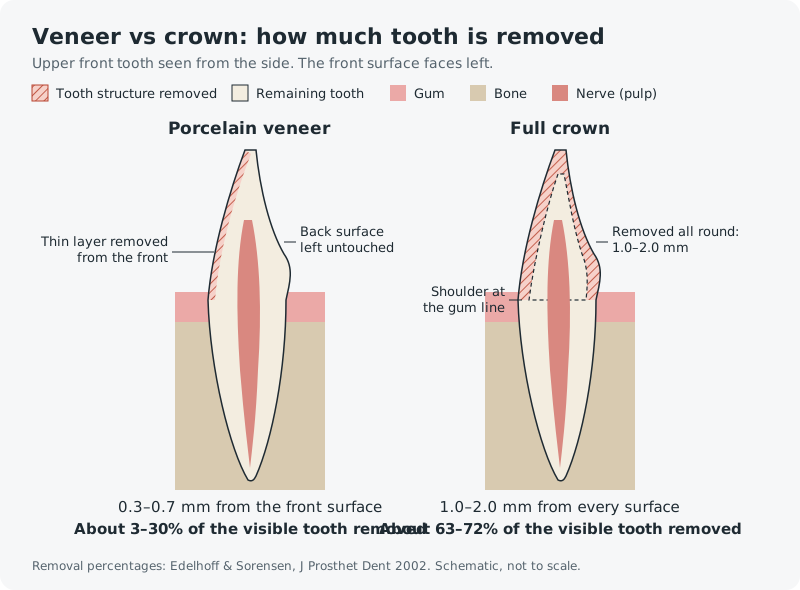
A true porcelain veneer covers only the front, visible surface of the tooth and sometimes wraps slightly over the biting edge. The preparation stays in enamel. Laboratory measurements show that veneer preparations remove roughly 3–30% of a front tooth's visible structure, while full crown preparations remove about 63–72%.1 Crowning vital teeth carries a long-term risk of pulp death, and every later replacement removes more tooth.
Well-planned veneers are among the most conservative and durable aesthetic treatments available. They suit:
- discolouration that does not respond to whitening;
- gaps between teeth;
- chipped or worn edges;
- teeth with an unsatisfactory shape;
- minor misalignment, usually after orthodontics.
Most smiles need 6–10 veneers, not 20, and not every tooth needs reducing. If you are unsure which veneer type suits you, our veneer comparison sets out the options side by side.
Enamel, Preparation Depth and Bonding
A veneer's durability depends on its bond to enamel. Etched enamel bonds strongly and permanently to resin; dentine is wetter and more organic, and bonds less predictably. The evidence is striking. In a 12-year study of 580 porcelain veneers, those with preparations confined to enamel had 99% survival, while veneers bonded to dentine, or with margins in dentine, were about ten times more likely to fail.2
Facial enamel is roughly 0.3–0.5 mm thick near the gum line, thickening to about 1.0 mm or more towards the biting edge. A conservative 0.3–0.7 mm facial reduction, graded from cervical to incisal, keeps the bond in enamel. Once the preparation crosses the enamel-dentin junction over a large area, bond quality falls and the risk of sensitivity and microleakage rises.
Preparing through a mock-up ensures enamel is removed only where the new outline requires it. A resin replica of the planned smile is placed over the teeth, and depth-cutting burs are used through it. This approach, developed by Turkish prosthodontist Galip Gürel as the aesthetic pre-evaluative temporary (APT) technique, kept over 80% of preparations within enamel in his long-term study.3 The design itself comes from a digital smile design.
Margins are placed at or just above the gum line, and interproximal margins just short of the contact points where possible. Existing composite fillings can often be incorporated and do not justify a crown. Where teeth are crowded, orthodontic alignment beforehand can allow near prep-less laminate veneers.
Ceramics, Thickness and Fabrication
Porcelain veneers are made from one of two ceramic types.
Feldspathic ceramic gives the finest aesthetics, with depth, translucency, fluorescence and opalescence closest to enamel. It is built up by hand using the refractory die technique: the master model is duplicated in heat-resistant investment, porcelain is layered and fired directly on it, and the investment is removed, leaving a veneer that can be as thin as 0.3 mm. It is weak on its own (roughly 70–120 MPa) but performs very well once bonded to enamel.
Pressed lithium disilicate (e-max veneers) is stronger, at around 400–500 MPa, and more consistent from laboratory to laboratory. It is typically 0.3–0.6 mm thick and suits firmer bites, with long-term survival data of around 95% at 10 years.4
For severely discoloured teeth, more opaque zirconium veneers may be needed.
Each veneer is etched and primed with silane, then bonded to etched enamel with a colour-stable light-cure resin cement; the adhesive bonding guide covers the details.
Glazed porcelain has excellent stain resistance. Coffee, tea and red wine do not discolour the ceramic itself. Over many years, the thin cement line at the margin may discolour slightly, especially if margins are imperfect.
Your Visit, Day by Day
Day 1: diagnosis and design. Photographs, scans and a clinical assessment identify which teeth actually need veneers, and whether whitening, bonding or orthodontics should come first. A digital smile design and wax-up follow.
Day 2: mock-up. A resin mock-up is placed over your existing teeth. You assess length, shape and speech, and approve the design before any tooth is prepared.
Day 3: preparation. Enamel is reduced through the mock-up, keeping the depth within 0.3–0.7 mm and margins in enamel. The final scan is taken and temporary veneers are fitted to the approved design.
Days 4–7: laboratory work. Veneers are layered on refractory dies or pressed.
Days 7–8: try-in and bonding. Shade is confirmed with try-in paste, then the veneers are bonded one at a time. Excess cement is removed and the bite adjusted.
Days 9–10: review. Gum health, bite and speech are checked, and a night guard is made if you grind.
What Veneer Quotes Leave Out
The trap that matters most is veneers advertised, crowns performed. Some clinics sell "veneers" online and then carry out full 360° crown preparations in the chair. Before treatment, ask for the planned preparation depth in millimetres and whether the back and sides of each tooth will be touched. Ask for photographs of the prepared teeth before anything is bonded.
Excessive tooth counts are the next warning sign. Quotes for 20–24 veneers based on selfies often include teeth that do not show when you smile. In Turkey, expect roughly £200–£450 per veneer; the same treatment typically costs £700–£1,300 or more in the UK.
Finally, check for an unspecified material and no mock-up. A quote that just says "porcelain" without naming the ceramic, the laboratory, or a mock-up and try-in step is incomplete.
Is It Right for You?
| Good fit | Think twice |
|---|---|
| Healthy teeth with adequate enamel, where colour, gaps, chips or shape have not been resolved by whitening or bonding | Severe crowding or bite problems needing orthodontics first, heavy grinding without a night guard, and teeth with little remaining enamel |
| Minor misalignment, often after orthodontic treatment | Active gum disease or untreated decay |
| Patients with healthy gums, a stable bite and realistic expectations of shade and size | Risks include debonding, chipping, sensitivity (especially where dentine is exposed), marginal staining, gum inflammation from overcontoured margins, and pulp damage when preparations are too deep |
Porcelain vs Composite Veneers
Composite veneers are built directly on the tooth in resin, usually with little or no preparation. They are cheaper and effectively reversible, but they stain, chip and lose their polish, and typically last 5–7 years before needing refurbishment.
Porcelain veneers need some enamel reduction and a laboratory stage, but offer superior translucency, stain resistance and longevity. Composite suits younger patients, minor changes and tight budgets; porcelain suits long-term change where some enamel preparation is justified.
Frequently Asked Questions
How can I know whether I am getting veneers or crowns?
Ask before treatment, in writing, for the planned preparation depth and design. A true porcelain veneer involves 0.3–0.7 mm of reduction on the front surface only, with margins in enamel, and leaves the back and most of the sides untouched. A crown involves 1.0–2.0 mm of reduction all round and removes around two-thirds of a front tooth's visible structure. Ask the clinic to photograph your prepared teeth and share the images before anything is bonded. If your teeth look like small pegs, you have had crown preparations.
Can veneers be done without shaving my teeth?
Sometimes. No-prep or minimal-prep veneers are possible when teeth are small, set back or spaced, so ceramic can be added without making them bulky. In practice, most cases need a small reduction, 0.3–0.5 mm in places, to avoid bulky teeth and to create a clear margin for bonding. Preparing through a mock-up means removing enamel only where the new outline requires it, and orthodontic alignment beforehand can greatly reduce the reduction needed. Claims of "no drilling" for every patient should be treated with caution.
Do porcelain veneers stain over time?
The ceramic itself is highly stain-resistant. Glazed porcelain does not absorb coffee, tea, red wine or tobacco stains in the way composite resin or natural enamel can. Over many years, the thin line of resin cement at the margin may pick up some discolouration, especially if the margins were not perfectly sealed or polished. Using colour-stable light-cure cement, finishing margins carefully and attending regular hygiene appointments all minimise this. Your natural teeth may darken slightly with age while the veneers stay the same shade.
What happens when my veneers need replacing?
Veneers are a lifelong commitment, because the enamel removed cannot be replaced. When a veneer eventually fails, the old ceramic and cement are removed and a new veneer is bonded. If the original preparation was conservative and stayed in enamel, this can usually be done with minimal additional tooth loss. Teeth that were crowned all round leave far less structure for future replacements, which is why conservative preparation at the outset matters so much.
References
- Edelhoff D, Sorensen JA. Tooth structure removal associated with various preparation designs for anterior teeth. J Prosthet Dent. 2002;87(5):503–509. doi:10.1067/mpr.2002.124094
- Gurel G, Sesma N, Calamita MA, Coachman C, Morimoto S. Influence of enamel preservation on failure rates of porcelain laminate veneers. Int J Periodontics Restorative Dent. 2013;33(1):31–39. doi:10.11607/prd.1488
- Gurel G, Morimoto S, Calamita MA, Coachman C, Sesma N. Clinical performance of porcelain laminate veneers: outcomes of the aesthetic pre-evaluative temporary (APT) technique. Int J Periodontics Restorative Dent. 2012;32(6):625–635. PubMed
- Aslan YU, Uludamar A, Özkan Y. Clinical performance of pressable glass-ceramic veneers after 5, 10, 15, and 20 years: a retrospective case series study. J Esthet Restor Dent. 2019. doi:10.1111/jerd.12496
- British Dental Association. Survey of 1,000 UK dentists on treatment abroad (July 2022). Reported in Dental Tribune UK. Article