Quick answer
Dental implants must respect minimum distances from teeth, other implants, nerves and sinuses, and must sit at a specific depth. These rules protect the bone between fixtures and preserve the gum papillae. They also explain why one implant per missing tooth is often not the best plan.
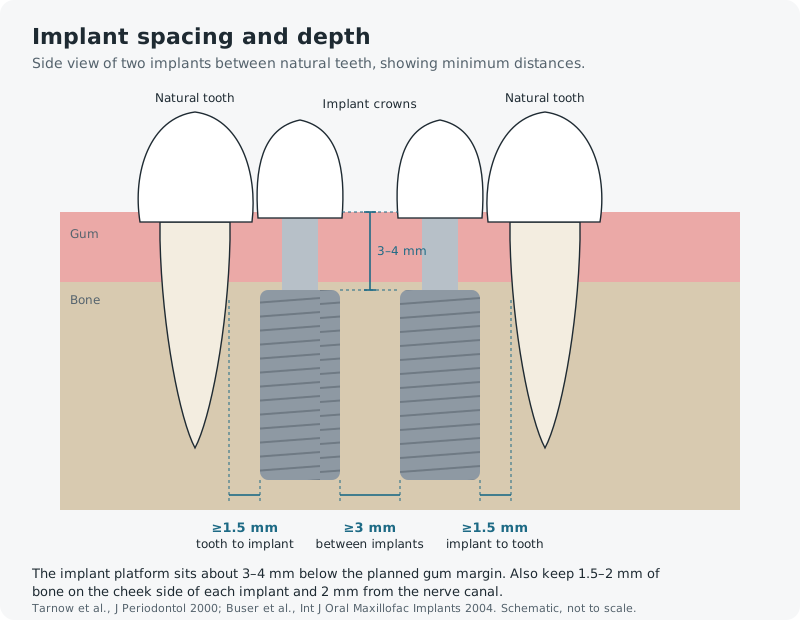
The core rules
| Rule | Typical minimum | Why it matters |
|---|---|---|
| Implant to natural tooth | 1.5 mm | Protects the tooth's root and the bone supporting its papilla |
| Implant to implant | 3 mm | Closer spacing leads to loss of the bone crest between implants |
| Buccal (cheek-side) bone | 1.5–2 mm | Thin bone resorbs, and the gum recedes with it |
| Depth | 3–4 mm below the planned gum margin | Room for a natural emergence profile without exposing metal |
| Distance to the nerve canal | 2 mm | Protects against nerve injury |
Thin bone on the cheek side, or an implant placed too far towards the cheek, is one of the main causes of gum recession and grey shadowing over implants at the front of the mouth.3,4
Implant-to-implant spacing
When two implants sit closer than about 3 mm, the zones of bone remodelling around each fixture overlap. The bone crest between them resorbs, and the papilla collapses.1 Even with correct spacing, the papilla between two adjacent implants tends to be shorter than between two natural teeth, averaging around 3–4 mm.2
Why fewer implants are often better
For a gap of three missing teeth, two implants supporting a bridge usually give a better result than three implants side by side. The pontic in the middle can be shaped to recreate a natural-looking papilla, less bone is needed, and there is one fewer site at risk of peri-implantitis. See multiple dental implants.
Guided surgery
Achieving these distances reliably, especially with several implants, is much easier with a surgical guide planned on a CBCT scan and a digital model of the final teeth.
Related guides
Multiple dental implants · Single tooth implant · Endosteal implants · Biological width
References
- Tarnow DP, Cho SC, Wallace SS. The effect of inter-implant distance on the height of inter-implant bone crest. J Periodontol. 2000;71(4):546–549. PubMed
- Tarnow D, Elian N, Fletcher P, et al. Vertical distance from the crest of bone to the height of the interproximal papilla between adjacent implants. J Periodontol. 2003;74(12):1785–1788. PubMed
- Buser D, Martin W, Belser UC. Optimizing esthetics for implant restorations in the anterior maxilla: anatomic and surgical considerations. Int J Oral Maxillofac Implants. 2004;19(Suppl):43–61. PubMed
- Grunder U, Gracis S, Capelli M. Influence of the 3-D bone-to-implant relationship on esthetics. Int J Periodontics Restorative Dent. 2005;25(2):113–119. PubMed